

Why Most Restoration Companies Sound Exactly the Same
Walk through any restoration company website and you’ll see the same phrases repeated: “24/7 emergency response,” “IICRC certified,” and “insurance approved.” Every water damage company claims fast response times. Every fire restoration business promises quality work.
Your unique selling proposition cuts through this noise by highlighting what makes your restoration business different from the 15 other companies serving your market. Without a clear USP, you’re competing solely on price and availability.
This guide shows you how to identify your competitive advantages and turn them into a marketing message that attracts higher-quality leads and justifies premium pricing.
What Makes a Strong Unique Selling Proposition for Restoration Work
A strong USP for restoration companies goes beyond listing services or certifications. It addresses specific pain points that property owners face during disasters.
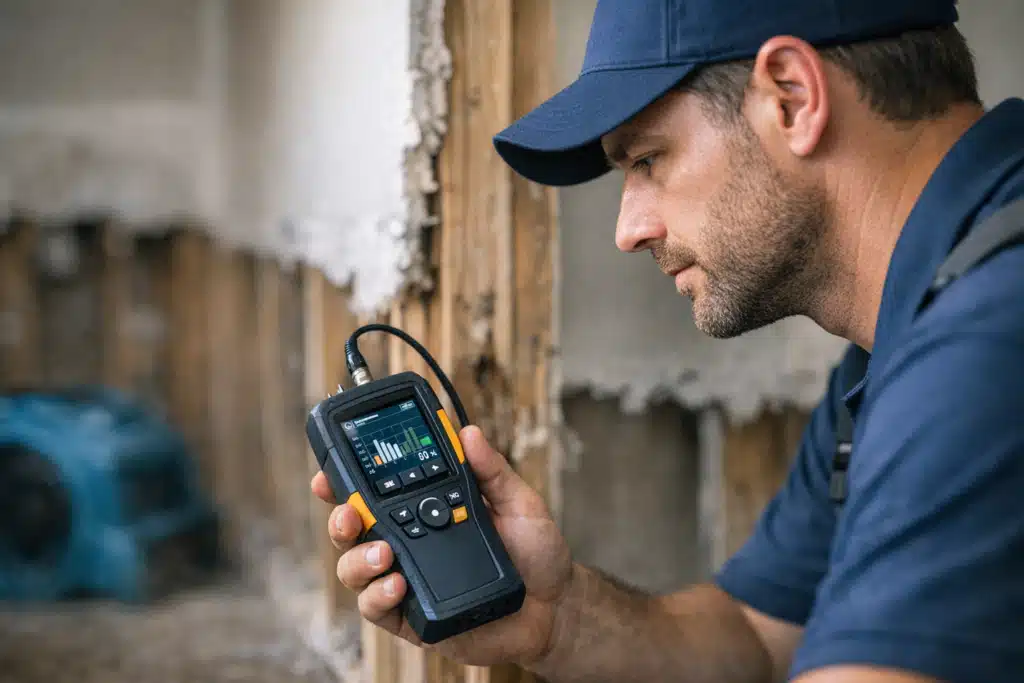
Consider two different approaches:
- Weak USP: “We provide 24/7 water damage restoration services”
- Strong USP: “We guarantee arrival within 90 minutes of your emergency call, or your inspection is free”
The second example creates urgency and reduces risk for the customer. It also gives you a measurable standard to maintain in your operations.
Focus on Customer Outcomes, Not Company Features
Property owners calling restoration companies are stressed, confused, and worried about costs. They want certainty during chaos.
Your USP should speak to emotional outcomes:
- Peace of mind through transparent pricing
- Confidence from clear communication
- Relief from handling insurance paperwork
Frame your advantages around what customers gain, not what you do. Instead of “We have advanced moisture detection equipment,” try “We find hidden water damage that prevents mold growth in your walls.”
Four Types of Restoration Business USPs That Drive Results
Most successful restoration companies build their USP around one of these four competitive advantages.
Speed and Availability Guarantees
Emergency restoration relies on fast response times. Many companies claim speed, but few guarantee it with specific promises.
Examples of speed-based USPs:
- “Water extraction begins within 2 hours, guaranteed, or we waive our emergency fee”
- “Same-day board-up service for all fire damage calls received before 6 PM”
- “We answer every call on the first ring – real people, not voicemail”
These guarantees work because they transfer risk from the customer to your business. They also create specific operational standards your team must meet.
Insurance Process Expertise
Insurance claims confuse most property owners. Companies that simplify this process can charge premium rates for the convenience.
Insurance-focused USP examples:
- “We handle 100% of your insurance paperwork and guarantee claim approval or we reduce our bill by 25%”
- “Direct insurance billing – you never pay out of pocket for covered repairs”
- “Former insurance adjuster on staff ensures maximum claim payouts”
Document your insurance approval rates and claim processing times to support these promises with data.
Specialized Equipment or Techniques
Advanced equipment can become a USP when you explain the customer benefits clearly.
Equipment-based positioning:
- “Thermal imaging cameras detect water damage invisible to standard inspections”
- “Hospital-grade air scrubbers remove 99.97% of airborne contaminants during restoration”
- “Truck-mounted extraction systems remove water 3x faster than portable units”
Always connect technical capabilities to practical outcomes. Customers care about results, not equipment specifications.
Warranty and Quality Assurance
Extended warranties reduce buyer risk and justify higher prices. Most restoration work comes with basic guarantees, so longer terms create differentiation.
Warranty-focused USPs:
- “5-year mold-free guarantee on all water damage restoration projects”
- “If odor returns within 2 years, we re-treat your property at no charge”
- “100% satisfaction guarantee – we’re not done until you’re completely happy”
Back these promises with detailed quality control processes and regular follow-up procedures.
How to Identify Your Restoration Business Competitive Advantages
Your USP must reflect real operational strengths. Empty promises damage credibility and create service delivery problems.
Analyze Your Current Operations
Review these areas for potential advantages:
- Response times: Track average arrival times for emergency calls
- Insurance relationships: Count preferred vendor agreements and approval rates
- Staff expertise: List certifications, specializations, and years of experience
- Equipment capabilities: Identify unique or advanced tools you own
- Project completion times: Measure average restoration timelines by damage type
Look for measurable differences between your performance and typical industry standards.
Survey Recent Customers
Ask customers who hired you over competitors why they chose your company. Their responses reveal perceived advantages you might not recognize.
Send a simple email survey with these questions:
- What convinced you to hire us instead of other restoration companies?
- Which part of our service exceeded your expectations?
- What would you tell friends about working with our company?
Pay attention to unexpected answers. Customers often value things you consider routine, like explaining the restoration process clearly or updating them daily on progress.
Testing Your USP Through Marketing Campaigns
A strong USP should improve your marketing performance across all channels. Test different versions to find the most effective messaging.
Google Ads Testing
Run separate ad campaigns highlighting different USP angles. Track which messages generate more calls and higher-quality leads.
Test variations like:
- Speed-focused ads: “90-minute response guarantee”
- Insurance-focused ads: “We handle all insurance paperwork”
- Quality-focused ads: “5-year mold-free warranty”
Run each variation for two weeks minimum to gather meaningful data on click-through rates and conversion quality.
Website Conversion Testing
Place your USP prominently on landing pages and measure impact on phone calls and contact form submissions.
Test placement in:
- Homepage hero section
- Service page headers
- Contact form areas
- Phone number click-to-call buttons
Track both quantity and quality of leads generated. A USP that attracts more price shoppers might hurt profitability despite increasing call volume.
Common USP Mistakes That Hurt Restoration Companies
Avoid these positioning errors that weaken your competitive advantage.
Making Promises You Can’t Keep
Overpromising response times or results creates negative reviews and damages local reputation. Build your USP around capabilities you can deliver consistently.
If your average response time is 2 hours, don’t promise 90-minute arrival. Promise what you can achieve 95% of the time.
Copying Competitor Messages
Using similar language to established competitors makes you look like a follower, not a leader. Research competitor USPs to identify gaps, not copy their positioning.
If three local companies emphasize speed, focus on quality or insurance expertise instead.
Being Too Broad or Vague
General statements like “best service” or “experienced team” don’t differentiate your restoration business from alternatives.
Specific claims with measurable outcomes perform better than broad promises. “15 years experience” becomes “Restored over 3,000 properties in the metro area.”
Implementing Your USP Across Marketing Channels
Once you’ve defined your USP, integrate it consistently across all customer touchpoints.
Website Integration
Feature your USP prominently on every page where customers might enter your site:
- Homepage header and hero section
- Service pages for water, fire, and mold restoration
- About page to reinforce credibility
- Contact page near phone numbers
Use the same language consistently to reinforce your positioning through repetition.
Google Business Profile Optimization
Include your USP in your Google Business Profile description and posts. Local searchers often see this information before visiting your website.
Create regular posts highlighting your USP benefits with photos from recent projects.
Emergency Response Scripts
Train phone staff to communicate your USP when booking emergency calls. First contact sets expectations for your entire relationship.
Example script opening: “Thanks for calling [Company Name]. We guarantee arrival within 90 minutes. Let me get your address and we’ll have a crew dispatched right away.”
Measuring USP Effectiveness
Track these metrics to determine if your USP improves marketing performance:
- Lead quality scores: Rate incoming calls based on project size and customer fit
- Conversion rates: Percentage of estimates that become signed contracts
- Average project value: Compare before and after USP implementation
- Customer acquisition cost: Track across Google Ads, SEO, and referral sources
A strong USP should increase both lead quality and pricing power over 3-6 months.
When to Update Your Restoration Business USP
Market conditions and competitive landscapes change. Review your USP annually and update when necessary.
Consider changes when:
- Multiple competitors adopt similar positioning
- You develop new capabilities or equipment
- Customer feedback reveals new priority concerns
- Marketing performance declines despite consistent execution
Your unique selling proposition should evolve with your restoration business capabilities and market demands. What differentiates you today might become standard practice industry-wide next year.
Start Differentiating Your Restoration Business Today
A strong USP transforms your restoration business from another option into the obvious choice for property owners facing disasters. Focus on specific promises you can deliver consistently rather than broad claims about quality or experience.
Test different positioning angles through your marketing campaigns and double down on messages that attract better leads and higher project values.
Ready to develop a USP that drives more emergency restoration leads? The Restoration Marketers specializes in helping disaster restoration companies stand out in competitive markets through strategic positioning and targeted digital marketing. Call 123-456-7890 to discuss your unique competitive advantages and how to turn them into marketing messages that generate results.
Sources
- U.S. Small Business Administration – Market Research and Competitive Analysis
- Institute of Inspection, Cleaning and Restoration Certification – Industry Standards
- Restoration Industry Association – Best Practices