

The Storm Season Reality: When Your Marketing Budget Gets Hit by a Hurricane
Your phone rings 200 times in 24 hours during a major storm, then goes silent for three weeks. This feast-or-famine cycle defines restoration marketing more than any other home services industry. **Storm season marketing** requires a completely different budgeting approach than the steady monthly spends that work for HVAC or plumbing companies.
Most restoration companies burn through their annual marketing budget in two months, then scramble when the next storm hits six weeks later. Others sit on fixed monthly budgets while competitors capture every available lead during peak demand.
The companies that thrive during storm season follow a flexible budgeting framework that scales up and down with weather patterns. Here’s how to build that framework for your restoration business.
How Storm Season Marketing Budgets Differ from Traditional Home Services
Traditional home services companies can predict monthly lead volume within 10-15%. Restoration companies see demand swings from 300% above normal to 60% below normal in the same quarter.
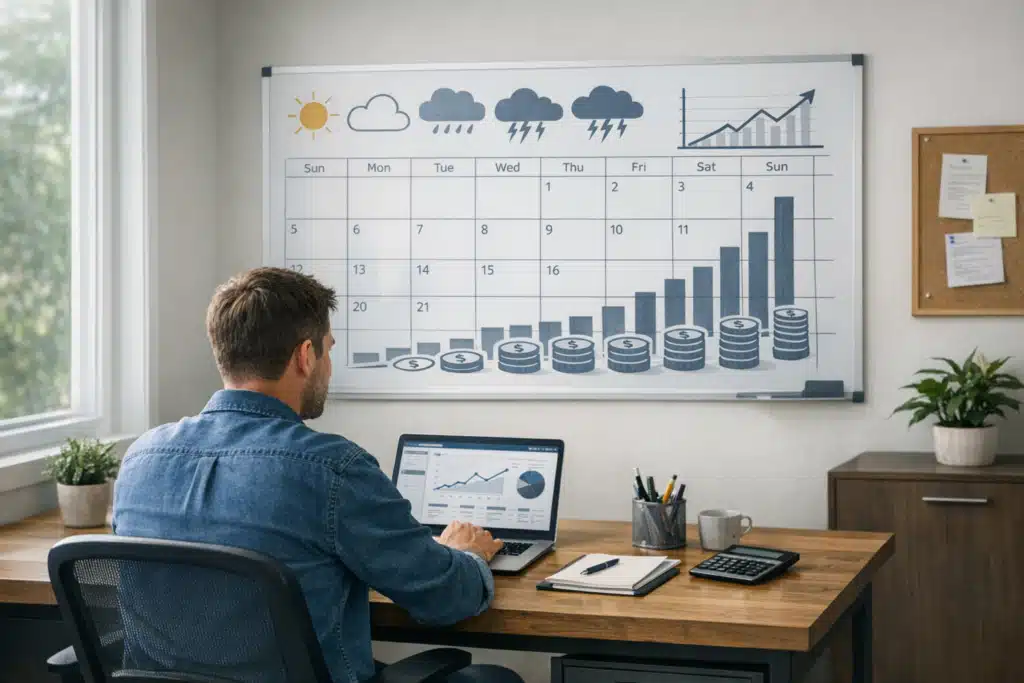
**Your marketing budget must flex with these dramatic shifts.** A fixed monthly Google Ads spend of $3,000 will either waste money during slow periods or miss massive opportunities during storms.
The most successful restoration companies we work with allocate 60-70% of their annual marketing budget to a “surge fund” that activates during weather events. The remaining 30-40% maintains baseline visibility during normal periods.
The Three-Tier Budget Structure
**Baseline Period (40% of annual budget):** Maintains local SEO rankings and captures routine water damage calls. Typical spend: $2,000-4,000 monthly for mid-sized markets.
**Pre-Storm Preparation (20% of annual budget):** Activates 48-72 hours before predicted severe weather. Increases ad spend by 150-200% and expands geographic targeting.
**Storm Response (40% of annual budget):** Full activation during and immediately after weather events. Can increase normal ad spend by 400-600% for 5-14 days.
Building Your Storm Season Marketing Reserve Fund
**Calculate your surge capacity before storm season starts.** Take your highest revenue month from the past two years and multiply by 1.5. This represents your maximum realistic capacity during a major event.
Your storm marketing budget should generate enough qualified leads to reach 80% of this capacity. If your average job value is $4,500 and you can handle 40 jobs during a two-week surge, budget $8,000-12,000 for that period.
Monthly Reserve Allocation Formula
Set aside surge funds using this approach:
- January-March: Save 60% of normal marketing spend into storm reserve
- April-June: Use storm reserve for spring severe weather season
- July-August: Rebuild reserve with 70% of normal spend
- September-November: Deploy reserve for hurricane/fall storm season
- December: Evaluate year and plan next storm budget
Rapid-Deploy Marketing Tactics for Storm Surges
Speed matters more than perfection when storms hit. Your competitors are launching campaigns within hours of weather warnings.
**Pre-build your storm response campaigns during slow periods.** Create separate Google Ads campaigns for each major weather type: flooding, wind damage, hail damage, and winter storms.
24-Hour Storm Activation Checklist
When severe weather approaches, execute this sequence:
- Hour 1: Activate pre-built Google Ads campaigns with 300% budget increase
- Hour 2: Update Google Business Profile with storm response messaging
- Hour 4: Launch Facebook ads targeting affected zip codes
- Hour 8: Send email blast to past customers in impact zone
- Hour 12: Expand geographic targeting if local competition is saturated
**Your phone system and landing pages must handle the surge.** Test your lead capture process at 5x normal volume before storm season starts.
Tracking Return on Investment During Demand Spikes
Storm season marketing generates different ROI patterns than normal periods. Cost-per-click increases 200-400% during major events, but conversion rates often double.
**Track leading indicators, not just final ROI.** Monitor phone call volume, form submissions, and quote requests hourly during storms. Revenue tracking comes weeks later after jobs complete.
Key Storm Marketing Metrics
Focus on these metrics during surge periods:
- Cost per phone call: Should stay under $40 even during peak demand
- Call-to-quote conversion: Target 70% or higher during emergencies
- Geographic penetration: Track which zip codes generate highest-value jobs
- Response time impact: Measure how callback speed affects close rates
**Set daily spending limits 50% higher than planned.** Google Ads can overspend by 200% on high-traffic days. Build buffers into your storm budgets.
Post-Storm Budget Reallocation Strategy
The two weeks after a major storm require different marketing tactics than the initial emergency response. Demand shifts from “help me now” to “insurance claim assistance.”
**Reduce emergency-focused ad spend by 60% after 72 hours.** Shift budget toward insurance restoration keywords and supplemental damage campaigns.
The 30-Day Post-Storm Sequence
**Days 1-3:** Emergency response at full budget
**Days 4-10:** Reduce emergency ads 60%, launch insurance claim campaigns
**Days 11-20:** Focus on supplemental damage and hidden issues
**Days 21-30:** Return to baseline spend, capture lingering opportunity
Many restoration companies miss the post-storm opportunity by cutting marketing too quickly. Insurance claims and secondary damage often generate higher-value projects than initial emergency work.
Seasonal Budget Planning for Multiple Storm Windows
**Plan for 3-4 major marketing activations per year.** Spring severe weather, summer storms, fall hurricanes, and winter freeze events each require budget allocation.
Your annual marketing calendar should identify peak risk periods for your geographic area. Gulf Coast companies need different allocation than Midwest or Northeast markets.
Regional Storm Season Timing
**Southeast/Gulf Coast:** 40% of storm budget for August-October hurricane season
**Midwest:** 35% for April-June tornado season, 25% for summer storms
**Northeast:** 30% for winter storms, 30% for summer severe weather
**Southwest:** 50% for monsoon season and flash flooding periods
**Never allocate 100% of surge budget to one event.** Multiple smaller storms often generate more total revenue than single major disasters.
Technology and Tools for Storm Marketing Management
Manual budget management fails during storm surges. Use automation tools to scale spending and pause campaigns based on call volume.
**Set up automated bid adjustments tied to weather data.** Services like Weather API can trigger campaign changes when severe weather warnings activate.
Call tracking becomes critical during high-volume periods. Route calls by service type and geographic area to measure which marketing channels perform best under pressure.
**Preparation beats perfection in storm season marketing.** Companies that plan flexible budgets and pre-build campaigns consistently outperform those that react after storms hit.
Smart budgeting means allocating resources across the entire storm cycle, not just the emergency phase. Build your surge fund during quiet periods and deploy strategically when weather strikes.
Ready to build a storm season marketing budget that scales with demand? Contact The Restoration Marketers at 123-456-7890 to develop your flexible budgeting framework and pre-built campaign system.
Sources
- National Weather Service – Strategic Plan for Weather Forecasting
- FEMA – National Planning Frameworks
- Institute of Inspection, Cleaning and Restoration Certification – Industry Standards