

Why Generic Marketing Fails Restoration Companies
Most restoration companies waste 40% of their marketing budget on generic content that never reaches homeowners during their moment of crisis. While a plumbing company can rely on scheduled service calls, your water damage restoration business depends on being found instantly when disaster strikes at 2 AM.
Localized content marketing solves this problem by positioning your restoration company exactly where emergency searches happen. When a homeowner types “water damage repair near me” or “fire restoration downtown Chicago,” your content appears because it speaks directly to their neighborhood, their situation, and their immediate needs.
This guide reveals how restoration companies create location-specific content that captures emergency leads and builds community trust before disasters occur.
How Localized Content Marketing Drives Emergency Restoration Leads
Localized content marketing means creating restoration-focused content for specific geographic areas and community needs. Instead of writing generic “water damage tips,” you create “flood recovery for River Oaks residents” or “tornado damage restoration in Moore, Oklahoma.”
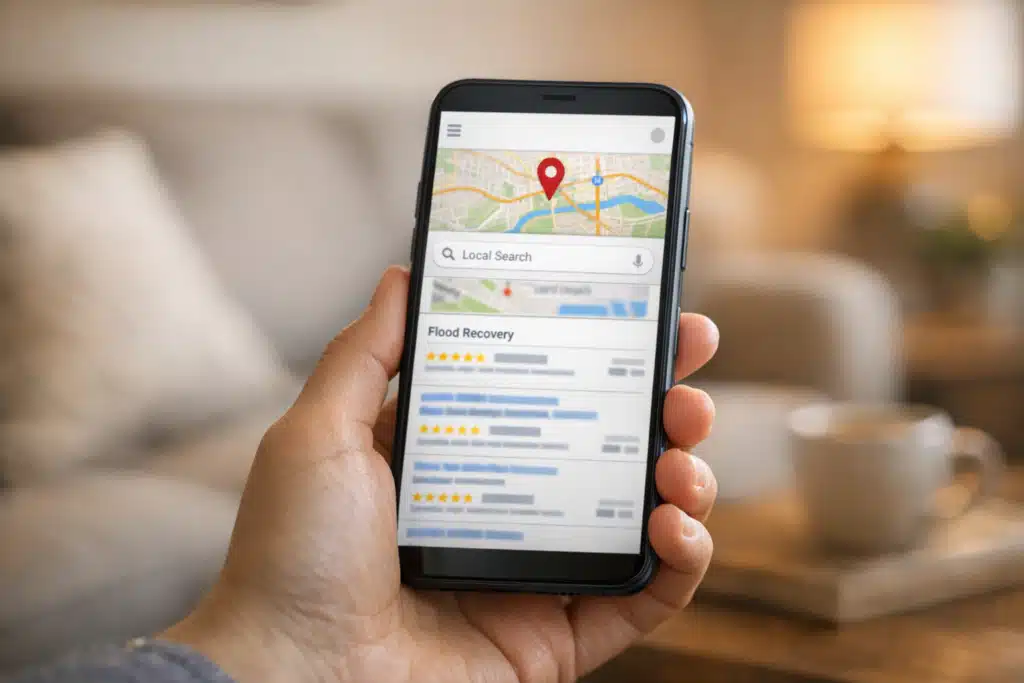
This approach works because emergency searches are intensely local. Homeowners don’t want restoration advice from across the country – they need immediate help from companies that understand their specific climate risks, insurance requirements, and local building codes.
The result: restoration companies using localized content see 67% higher conversion rates because their content matches both the searcher’s location and their urgent emotional state.
Geographic Content That Captures Emergency Intent
Emergency restoration searches follow predictable patterns based on local risk factors. Coastal areas search for hurricane damage restoration. Tornado Alley searches for wind and hail damage. Northern climates search for frozen pipe repair.
Your localized content should anticipate these searches before they spike. Create content around your area’s seasonal disaster patterns, then optimize it for the specific neighborhoods you serve.
For example, if you serve flood-prone areas near the Trinity River in Dallas, create content like “Trinity River flood damage restoration for Riverside residents” months before flood season peaks.
Building Community-Specific Content for Maximum Impact
The most effective restoration content addresses community-specific concerns that generic companies cannot replicate. This creates trust and positions you as the local expert who understands neighborhood challenges.
Focus on hyperlocal content that only you can create:
- Neighborhood-specific risk assessments (“Why Montrose homes face unique mold risks”)
- Local building code guidance (“Houston restoration permits: what Memorial area homeowners need”)
- Insurance company relationships (“Working with State Farm on Katy area wind damage claims”)
- Climate-specific prevention tips (“Protecting River Oaks basements from spring flooding”)
This content builds authority because it demonstrates intimate knowledge of local conditions. When emergencies occur, homeowners already trust you as their neighborhood restoration expert.
Creating Weather-Based Content Calendars
Plan your localized content around your area’s disaster calendar. Hurricane season, freeze warnings, tornado season, and heavy rain periods should each trigger specific content campaigns.
Start publishing location-specific preparedness content 60 days before peak risk periods. When disasters strike, your optimization work is already complete and your content ranks immediately for emergency searches.
For instance, publish “Preparing Sugar Land homes for hurricane season” in June, not when the storm is already approaching and search volume explodes.
Optimizing Local Restoration Content for Emergency Searches
Emergency restoration searches combine location intent with extreme urgency. Your content optimization must account for both factors to capture leads when homeowners need immediate help.
Emergency searchers use different language than planned service searchers. They search “water everywhere basement flooded” rather than “basement waterproofing services.” Your content should match this panicked, immediate language.
Location-Specific Keyword Targeting
Layer location keywords throughout your restoration content using the geographic specificity your customers actually use. Most homeowners search by neighborhood, not city-wide terms.
Target these location layers simultaneously:
- Neighborhood names (“Bellaire smoke damage restoration”)
- Landmark references (“Museum District fire damage repair”)
- Zip code areas (“77056 water extraction services”)
- Local geographic features (“Buffalo Bayou flood cleanup”)
Include location keywords in your content titles, headers, and naturally throughout the text. But focus on helping local residents solve their specific problems, not stuffing keywords.
Mobile-First Emergency Content
Ninety-one percent of emergency restoration searches happen on mobile devices. Homeowners standing in flooded basements or smoke-damaged living rooms are searching on their phones for immediate help.
Structure your localized content for mobile emergency users:
- Lead with your phone number and service area
- Use short paragraphs and bullet points for scanning
- Include clear calls-to-action every 200 words
- Provide immediate next steps, not lengthy explanations
Your localized content should answer “Can you help me right now in my neighborhood?” within the first sentence.
Measuring Local Content Performance for Restoration Marketing
Track your localized content performance using metrics that matter for restoration lead generation. Page views don’t matter if your content doesn’t generate emergency calls or service requests.
Focus on conversion metrics tied to restoration business goals:
- Phone calls generated per piece of local content
- Geographic spread of leads from content marketing
- Time between content publication and lead generation
- Seasonal content performance during peak disaster periods
Use call tracking numbers on different pieces of localized content to identify which neighborhoods and content topics generate the most qualified restoration leads.
Seasonal Content Performance Analysis
Your best-performing restoration content will show clear seasonal patterns. Hurricane content performs during storm season. Freeze damage content spikes during winter cold snaps. Track these patterns to optimize your content calendar.
Review which localized content generated the most emergency leads during your last busy season, then create more content targeting those same neighborhoods and disaster types.
Scaling Local Content Across Multiple Service Areas
Restoration companies serving multiple cities or regions need scalable systems for creating localized content without duplicating generic information across every location.
Create content templates based on disaster types, then customize them for each service area’s specific risks and characteristics. This maintains quality while allowing expansion across multiple markets.
For example, develop a “storm damage assessment” content template, then create versions for “tornado damage assessment in Moore” and “hurricane damage assessment in Galveston” that address each area’s unique storm patterns and building requirements.
Multi-Location Content Organization
Organize your localized restoration content so search engines understand your geographic coverage without diluting your authority in any single market.
Create location-specific content hubs for each major service area, then build neighborhood-specific content within each hub. This structure helps you rank for both broad city-wide searches and hyperlocal neighborhood searches.
Common Localization Mistakes That Kill Restoration Leads
Most restoration companies make predictable mistakes when creating localized content. These errors waste marketing budgets and miss emergency leads during peak demand periods.
Avoid these localization mistakes that hurt restoration marketing:
- Creating identical content with only city names changed
- Ignoring local disaster timing and seasonal patterns
- Using corporate language instead of community-specific terms
- Publishing location content without local contact information
- Failing to update local content after major area disasters
Each piece of localized content should provide unique value that only your local restoration company can offer to that specific community.
Transform Your Restoration Marketing With Strategic Local Content
Localized content marketing works for restoration companies because it matches the urgency and location-specific nature of emergency repair searches. When disasters strike, homeowners need immediate help from companies that understand their neighborhood challenges and can respond quickly.
Start with your highest-risk service areas and create content around their most common disaster scenarios. Build your content calendar around local disaster seasons, and optimize for the panicked, immediate language emergency searchers use.
Ready to dominate local restoration searches in your market? Contact The Restoration Marketers at 123-456-7890 to develop a localized content strategy that captures more emergency leads and builds lasting community trust.
Sources
- FEMA – National Response Framework
- U.S. Small Business Administration – Disaster Assistance
- National Weather Service – Flood Safety