
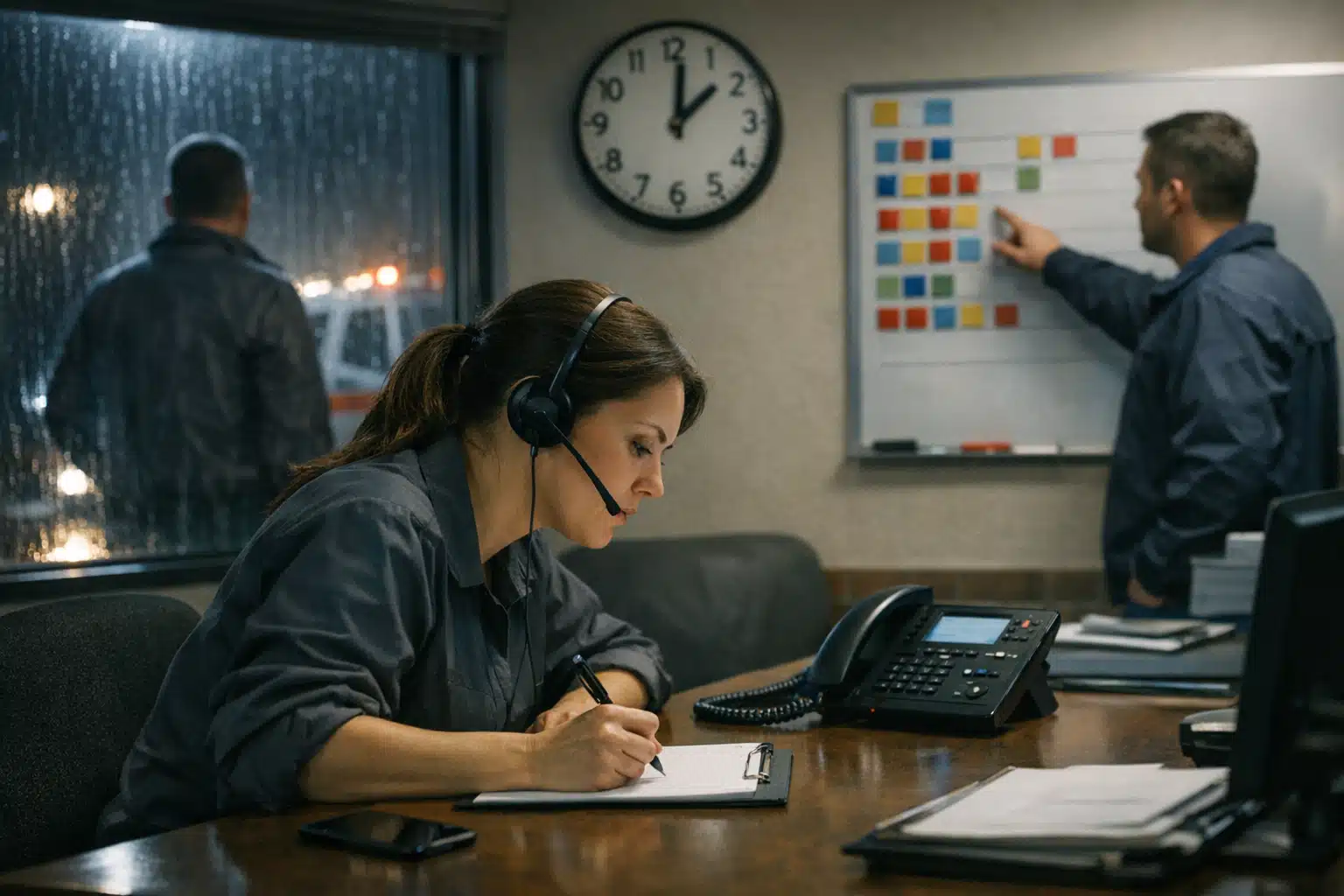
Your phone rings at 2 a.m. during a storm surge, and your office has 90 seconds to decide: send a truck or lose money. Most restoration companies dispatch crews on gut feeling, then eat the cost when the “flood” turns out to be a mop-and-bucket job. The right restoration lead qualification questions separate real emergencies from time-wasters before a technician leaves the lot.
This post gives you a dispatch-ready 5-question phone screen built for restoration work, not generic home services. Each question maps to claim likelihood, scope size, and who has authority to approve the job.
You will learn exactly what to ask, why it matters, and how to score the answers in under two minutes.
Why Restoration Call Screening Is Different From Other Home Services
A plumber qualifies a lead by job type and availability. A restoration company qualifies by insurance claim potential, water category, and scope. Those variables decide whether a job pays $800 or $18,000.
Dispatching a three-person crew plus equipment to a non-covered, 10-square-foot leak burns your margin. A good water damage call screening script protects both your schedule and your profit.
During peak storm weeks, call volume can triple overnight. Without a screen, your office sends trucks to every ring and misses the jobs that fund your month.
The Cost of Dispatching Blind
Say your loaded crew cost runs $140 per hour with equipment. A 45-minute round trip to a dead lead costs you more than $100 before anyone touches a wet wall.
Multiply that by 8 bad calls a week during storm season. You have lost $800 a week on jobs that never had a chance.
Screening is not about turning away work. It is about dispatching the right work first.
The 5 Restoration Lead Qualification Questions That Decide Dispatch
Each question below pulls one piece of decision data: urgency, scope, water category, insurance, and access. Ask them in order and your office can score a call fast.
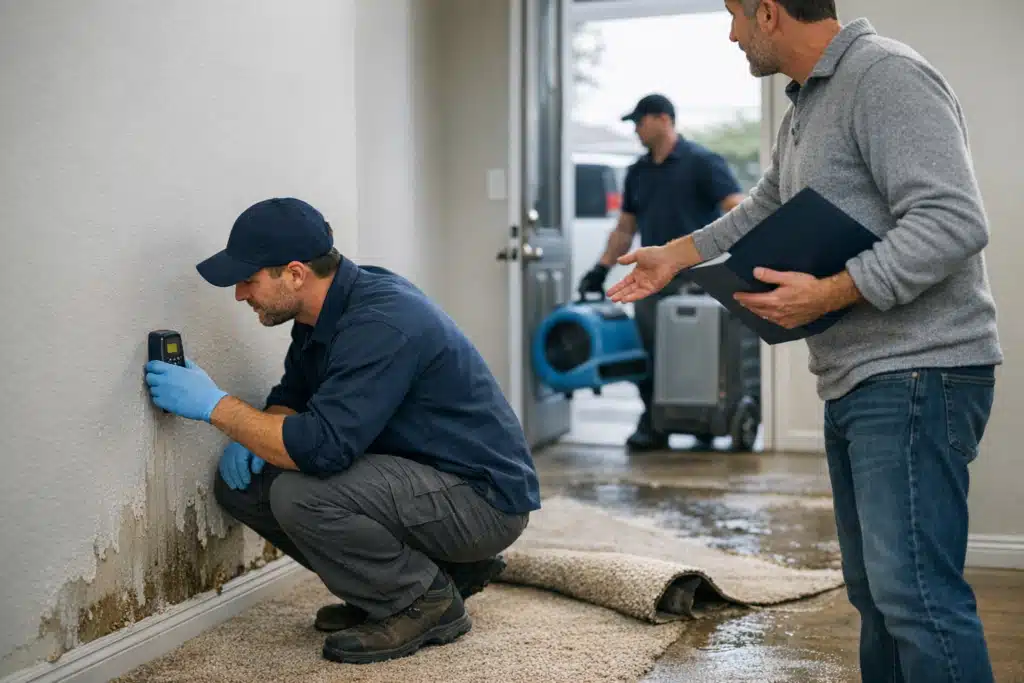
The goal is a conversation, not an interrogation. Train your team to ask warmly and listen for the details that predict a profitable job.
Question 1: “What’s happening right now, and when did it start?”
This single question reveals urgency and category at once. A ceiling dripping for 20 minutes is different from a basement that flooded three days ago.
- Active and recent (under 24 hours): High claim likelihood, dispatch priority.
- Standing for days: Mold risk rises, scope grows, still worth a visit.
- Already dried on its own: Low urgency, schedule an inspection instead of a crew.
The timeline tells you how fast water spread and how much material it touched.
Question 2: “Where is the water coming from?”
The source sets the water category, which drives price and PPE. Clean supply-line water is Category 1. A sewage backup is Category 3 and commands a far higher scope.
Ask follow-ups to pin it down:
- Burst pipe or supply line = clean water, straightforward dry-out.
- Washing machine or dishwasher overflow = gray water.
- Toilet overflow with waste or sewer line = black water, biohazard scope.
- Storm or groundwater = category depends on contact, usually Category 3.
The source answer often predicts the dollar value of the job before you arrive.
Question 3: “Roughly how much area is affected?”
Scope size tells your office how many technicians and air movers to load. Ask the caller to pace it out in rooms or to compare it to a known space.
Try: “Is it about the size of a closet, a bedroom, or more than one room?” Non-technical callers answer that easily.
- One room or less = single-tech inspection.
- Multiple rooms or floors = full crew and extraction gear.
- Whole basement or commercial space = multi-day project, schedule accordingly.
This keeps you from sending a solo tech to a job that needs a trailer of equipment.
Question 4: “Have you contacted your insurance company yet?”
Insurance status predicts whether the job gets paid and how big it becomes. A homeowner planning to file a claim is your highest-value lead.
Listen for three signals:
- “Yes, I filed a claim” = funded job, insurance scope, dispatch now.
- “I’m not sure if I should” = coach gently; most water losses are covered events.
- “I’m paying out of pocket” = smaller scope, confirm budget before you roll a crew.
Insurance-funded jobs carry larger scopes and faster approvals than cash jobs. This question alone sorts your dispatch priority.
Question 5: “Are you the homeowner, and can you meet us on-site?”
Access and authority decide whether a dispatched truck can actually start work. A tenant who cannot approve repairs stalls the whole job.
You need the person who can sign a work authorization and let your crew in.
- Owner or authorized decision-maker on-site = green light.
- Tenant only, landlord unreachable = confirm authority before dispatch.
- Property manager involved = get their direct contact before rolling.
Sending a crew to a locked house with no signer is a guaranteed loss.
How to Score the Call in Under Two Minutes
Give your office a simple tally. Count how many answers land in the high-value column across the five questions.
- 4–5 strong answers: Dispatch immediately, treat as priority.
- 2–3 strong answers: Schedule a same-day inspection, confirm details.
- 0–1 strong answers: Book an appointment, no emergency crew.
This turns a judgment call into a repeatable step any team member can run. New hires screen as accurately as your veteran dispatcher.
A written scoring sheet removes emotion and panic from storm-season dispatch.
Train the Tone, Not Just the Words
Callers in a flooding home are stressed. The water damage call screening script works only when your team sounds calm and helpful.
Start with reassurance: “We handle this every day, let me get a few details and we’ll get help moving.” Then run the five questions.
People answer honestly when they feel helped, not screened.
Connect Your Screen to Your Marketing Data
Your phone screen produces data that should feed your lead strategy. Track which marketing sources send the highest-scoring calls.
Tag every call by source in your CRM, then compare scores. You may find Google Ads sends cash jobs and local SEO sends insurance claims, or the reverse.
- Log the lead source on every screened call.
- Record the final score and whether you dispatched.
- Match sources to closed, paid jobs each month.
The channels that send high-score calls deserve more of your ad budget. The ones sending dead leads need fixing or cutting.
This is where many restoration owners find their real cost-per-job. A cheap lead that never scores high is more expensive than a pricier one that funds a $15,000 claim.
Use Screen Data to Fix Your Landing Pages
If callers keep saying “my water already dried,” your emergency ads are reaching non-emergency searchers. Your landing page messaging may be pulling the wrong intent.
Adjust your page copy to speak to active, flooding situations. The right visitors call, and your screen scores climb.
Putting the Phone Screen to Work This Storm Season
A tight 5-question screen protects your crew hours, raises your average job value, and sorts insurance-funded work to the top. Pair it with source-tagged call tracking and your marketing spend starts matching your best jobs.
Restoration growth comes from dispatching smart and spending on channels that send real emergencies.
Want help connecting your call data to a lead strategy built for restoration work? Call or text The Restoration Marketers at 720‑885‑0749, or visit https://restorationmarketers.com.