
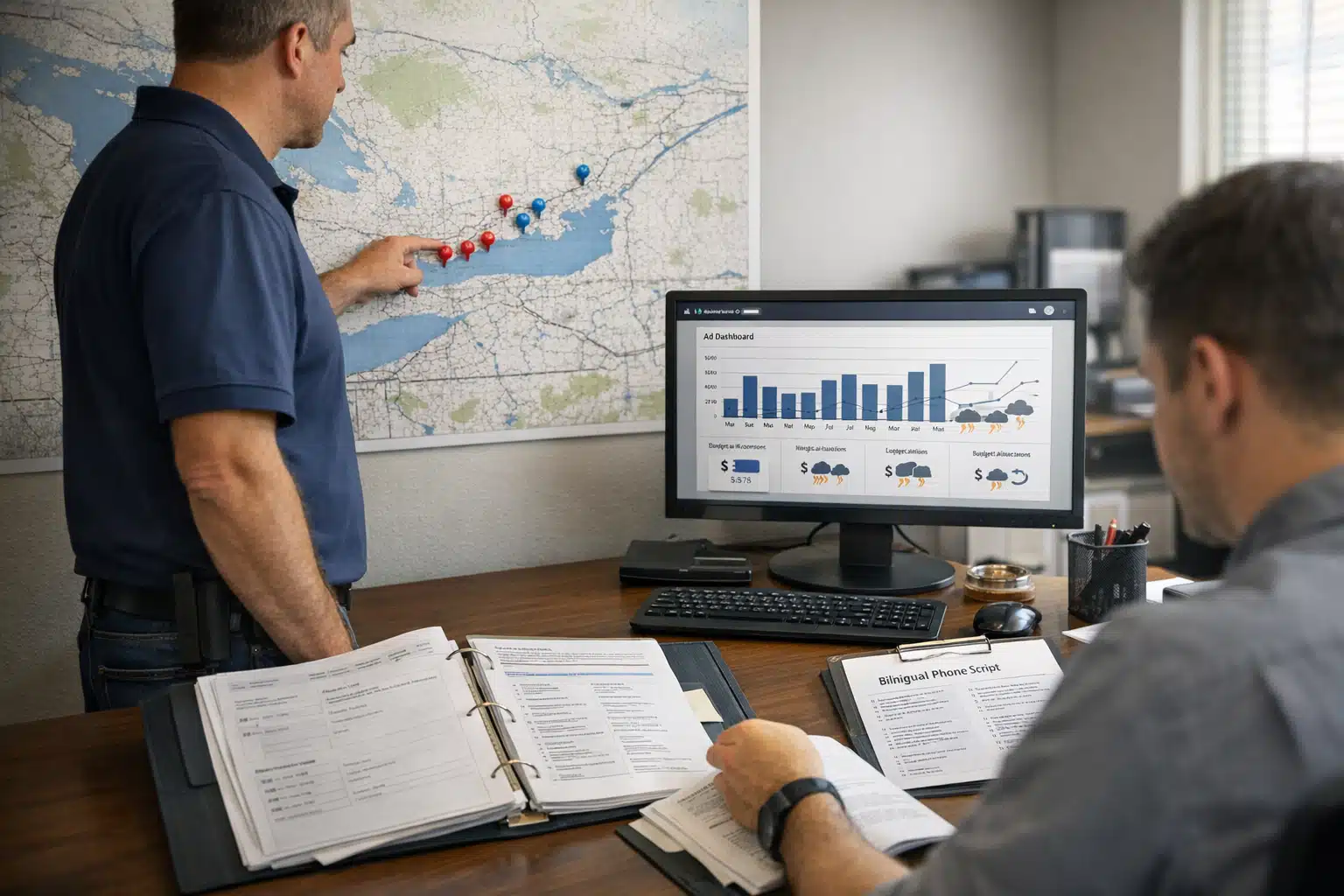
Why Restoration Companies Look Beyond Their Home Market
A single hurricane season can spike demand in one region and leave crews idle in another. Cross-border storm work, franchise territory growth, and multilingual customer bases push owners to try international marketing for the first time.
This post breaks down what works when a restoration business targets customers or partners outside its home country. You will learn how to research foreign demand, adapt local SEO for new languages, and set ad budgets that match storm calendars in different climates.
The goal is practical: fewer wasted dollars, more qualified leads, and a clear path into markets your competitors ignore.
What International Marketing Means for a Restoration Business
International marketing for restoration companies means adapting your lead generation, SEO, and paid ads to reach customers in a different country, language, or regulatory environment. It is not the same as running your usual campaigns with a wider radius.
A water damage company in Detroit expanding into Windsor, Ontario faces different insurance rules, spelling conventions, and search behavior. A firm chasing post-hurricane rebuilds in the Caribbean deals with seasonal timing that flips from its U.S. calendar.
The mechanics differ from general home services marketing in three ways:
- Insurance dependency: Referral networks and adjuster relationships do not transfer across borders.
- Emergency intent: Flood and fire searches happen in the local language during panic moments.
- Seasonal reversal: Storm and freeze seasons hit different regions at opposite times of year.
Where the Real Opportunities Are
Not every foreign market rewards a restoration company. The best targets share high property values, private insurance markets, and weather patterns that create steady damage.
Cross-Border Regional Work
The strongest first step is a neighboring country within driving distance. A Buffalo restoration firm can bid on southern Ontario losses without flying crews overseas.
Register a local phone number and address before running ads in a new country. Google Business Profile ranking depends on proximity signals that a foreign HQ cannot fake.
Post-Disaster Rebuild Contracts
Large storms in the Caribbean, Gulf, and coastal Mexico draw restoration crews from abroad. Insurers and government contracts fund much of this rebuild work.
Marketing here focuses less on Google Ads and more on visibility with adjusters, general contractors, and disaster response agencies. A ranked, English-and-Spanish website builds credibility when a procurement team searches your name.
Franchise and Licensing Growth
Some owners export their brand instead of their trucks. If you license your model to operators abroad, your marketing shifts to recruiting partners, not homeowners.
How to Adapt Local SEO for a New Country
Local SEO for international restoration work means building a separate, country-specific web presence rather than stretching one site across borders. Search engines rank pages by location signals, and mismatched signals hurt rankings.
Follow this order when entering a new market:
- Set up a country-specific URL structure. Use a country domain or a subfolder like /ca/ for Canadian pages.
- Match spelling and terms to local usage. British-English markets search “water damage restoration,” but phrasing and insurance vocabulary shift.
- Create a real local address and phone. A verifiable presence unlocks Google Business Profile rankings.
- Translate service pages with a fluent human. Machine translation of emergency copy reads wrong and kills trust.
- Earn local citations. List on the target country’s directories, not just U.S. ones.
Hreflang tags tell Google which page version to show which country. Skip them and your U.S. page may outrank your local page in the exact market you paid to enter.
Multilingual Emergency Pages
A homeowner with a flooded basement in Montreal may search in French. Your landing page should load in French, list a local number, and show a form built for panic-mode users.
Keep the emergency call button above the fold in every language. Speed matters more than polish when someone is standing in two inches of water.
Budgeting Paid Ads Across Different Storm Seasons
Seasonal timing is where international marketing rewards restoration owners most. When your home market goes quiet, another region may enter peak damage season.
Map your ad spend to each market’s weather calendar:
- U.S. Gulf Coast: Hurricane spend peaks June through November.
- Canada: Frozen pipe and ice dam demand climbs December through March.
- Australia and Southern Hemisphere: Flood season runs opposite the U.S. calendar.
A company running crews in two hemispheres can keep marketing spend productive year-round. Idle season in one market funds the busy season in another.
Currency and Bid Management
Run separate ad accounts per country and set budgets in local currency. Mixing currencies inside one account distorts cost-per-lead reporting and hides which market performs.
Track cost-per-lead in each currency, then convert only for comparison. A lead that looks expensive in raw dollars may be cheap after exchange rates and higher local job values.
Tracking Leads by Country and Source
Expanding across borders multiplies your lead sources. Without clean tracking, you cannot tell which market earns money and which drains it.
Set up tracking this way:
- Use a separate call-tracking number per country. This isolates phone leads by market and campaign.
- Tag every form with its source and region. Know if a Canadian lead came from search, maps, or a referral.
- Report cost-per-acquired-job, not cost-per-lead. Some markets produce cheap leads that rarely close.
- Review by region monthly. Cut spend fast in markets that lag after two full seasons.
Judge a new market on booked jobs, not clicks or calls. Foreign traffic that never converts is a signal to pull back, not spend more.
Reputation Management Across Borders
Reviews carry different weight in different countries. In some markets, Facebook and local directories outrank Google reviews for trust.
Ask for reviews on the platform locals check first. A five-star Google profile means little if buyers in that market read a different site.
Respond to reviews in the reviewer’s language. A silent or English-only response after a bad review in a French or Spanish market signals you do not belong there.
Common Mistakes When Going International
Most failed cross-border pushes repeat the same errors. Avoid these before you spend a dollar abroad:
- Running U.S. pages at foreign traffic. Wrong location signals waste budget and confuse ranking.
- Ignoring local insurance rules. Claims and referral paths differ by country and change your lead strategy.
- Skipping licensing checks. Some regions require local registration before you can legally bid.
- Auto-translating emergency copy. Panic-mode readers abandon pages that sound foreign or robotic.
Conclusion
Cross-border growth pays off when you match ad spend to each region’s storm calendar, build country-specific SEO, and track results by booked job instead of raw leads. International marketing lets a restoration business stay busy year-round by chasing demand across seasons and borders. Start with one neighboring market, prove the numbers, then scale.
Ready to take your restoration business into new markets the right way? Call or text The Restoration Marketers at 720‑885‑0749, or visit https://restorationmarketers.com to plan your expansion.
Sources
- Google Search Central – Managing Multi-Regional and Multilingual Sites
- National Hurricane Center (NOAA) – Tropical Cyclone Climatology
- U.S. International Trade Administration – Country Commercial Guides