
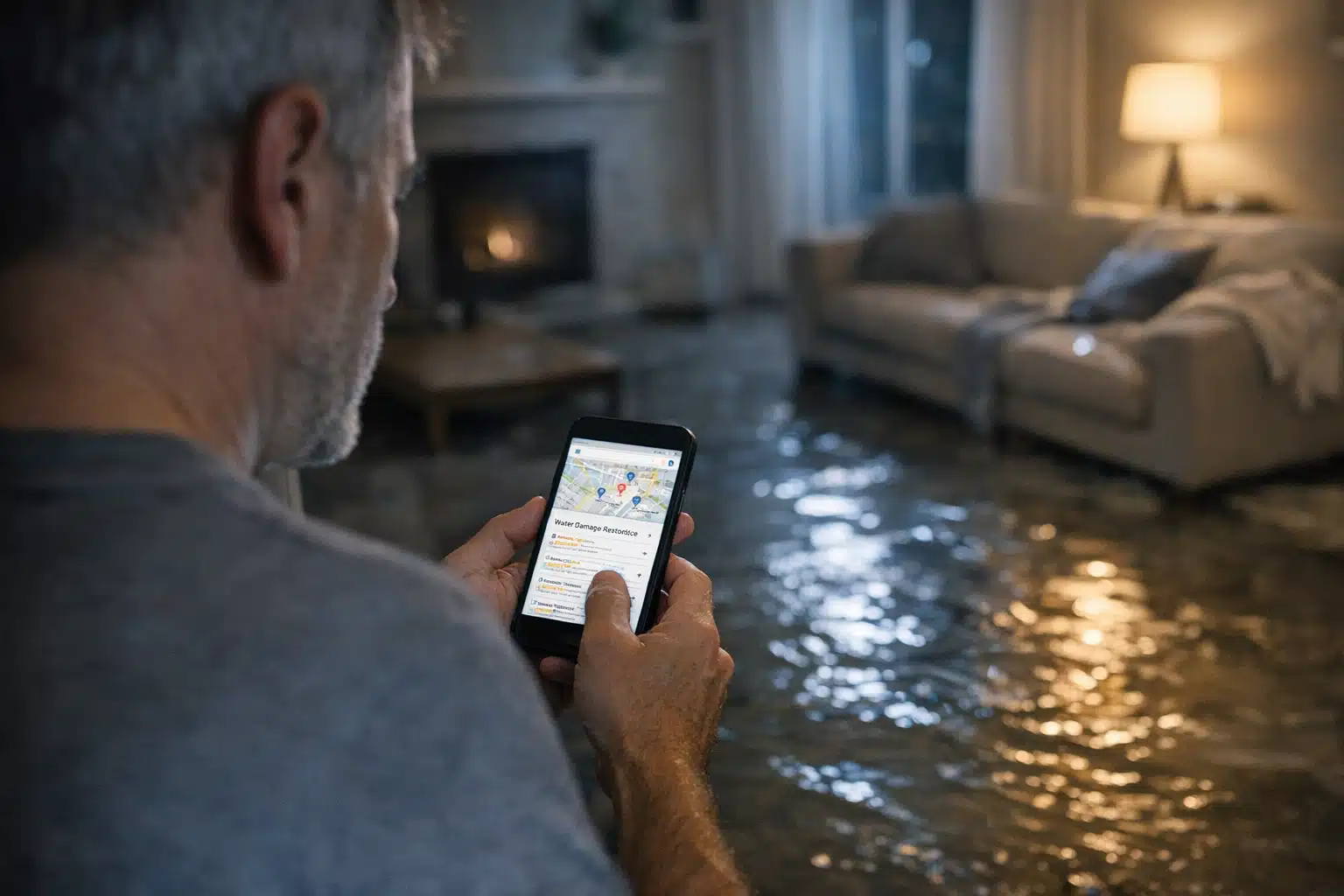
A burst pipe at 2 a.m. does not wait for your marketing to catch up. Homeowners grab their phone, type “water damage near me,” and call the first credible company they find. If your ads are not showing in that exact moment, a competitor pockets a $3,000 mitigation job that should have been yours.
This is where localized PPC campaigns earn their keep for restoration owners. You are about to learn how hyper-local pay-per-click strategies lower cost-per-lead, match ad spend to storm season, and turn panicked searches into booked jobs.
The math matters here. When a single water job averages $2,500 to $4,000, a $40 click that converts pays for itself many times over.
Why Localized PPC Campaigns Outperform Broad Advertising for Restoration
A localized PPC campaign means targeting paid search ads to a tight radius around your service area, matched to emergency-intent keywords. You bid on searches like “flooded basement Aurora” instead of “restoration company,” which wastes budget on people 200 miles away.
General home services marketing sprays ads across broad regions. Restoration demand does not work that way. A homeowner with three inches of standing water calls someone who can arrive in 45 minutes, not two states over.
Tight geographic targeting is the single biggest lever for restoration ad ROI. The closer your ad matches the searcher’s zip code and urgency, the higher your conversion rate climbs.
The ROI Difference in Real Numbers
Here is a scenario we see repeatedly with restoration clients. A company runs statewide ads with a $5,000 monthly budget and gets 25 leads at $200 each.
Rebuild the same budget around five tight zip-code clusters and the picture changes. The same $5,000 produces 60 to 70 leads because wasted clicks drop and intent-match rises.
Cutting your service radius from 50 miles to 15 miles frequently doubles qualified lead volume on the same spend.
Matching Ad Budget to Storm Season and Demand Spikes
Water damage demand is not flat. It jumps during spring thaw, hurricane landfall, and the first hard freeze that cracks pipes. Your PPC budget should move with these curves.

A restoration owner in Denver has different pressure points than one in Houston. Denver spends heavier in January and February when frozen pipes burst. Houston loads budget into June through November for tropical storms.
How to Budget Ads by Season
- Map your last three years of job data. Pull the months when water calls spiked and note the weather event behind each surge.
- Set a baseline budget for slow months. Keep ads live year-round so your Quality Score and ad history stay strong.
- Reserve a storm reserve fund. Hold 30% of annual ad budget for rapid scale-up during named storms or freeze warnings.
- Raise bids 48 hours before forecasted events. Search volume climbs before the storm hits, and early bidders capture the cheapest clicks.
- Pause or trim during dead weeks. Shift dollars from calm periods into the next predictable spike.
Restoration owners who pre-fund storm response capture leads at half the cost of those who react late. By the time a competitor notices the storm, click prices have already jumped.
Building Landing Pages That Convert Emergency Calls
Sending PPC traffic to your homepage wastes money. A homeowner in crisis needs one thing: a phone number and proof you can help right now.
A dedicated water damage landing page should load in under two seconds. Every extra second of load time bleeds off callers who are already stressed.
What an Emergency Landing Page Needs
- A tap-to-call button above the fold so mobile users reach you in one thumb press.
- A clear response-time promise like “On-site in 60 minutes across Jefferson County.”
- Trust signals near the call button — IICRC certification, insurance-direct billing, and review count.
- City and neighborhood names in the copy to match local search terms and reassure the caller.
- A short form as a backup for people who cannot talk, such as those at work during a home flood.
Mobile tap-to-call converts restoration traffic three to four times better than a contact form. Most emergency water searches happen on a phone, standing in a wet room.
Tracking Leads by Source to Protect Your Budget
You cannot improve what you cannot measure. Many restoration owners fund PPC blindly and never know which keywords produce paying jobs.
Call tracking is the backbone of restoration PPC. Assign a dynamic tracking number to your ad campaigns so every call ties back to its source.
The Tracking Setup That Separates Waste From Winners
- Use call tracking numbers that swap based on the traffic source, not one static line.
- Record calls to score lead quality — a call is only a win if it was a real water job, not a vendor.
- Tag leads by revenue, not volume. Ten cheap leads that never close lose to three that book $3,000 jobs.
- Feed closed-job data back into Google Ads. The algorithm then chases searches that look like your past buyers.
Restoration PPC without call tracking is guesswork with a credit card attached. Once you connect calls to closed revenue, you can defund losing keywords in a day.
Reputation Recovery and PPC Working Together
Paid ads send traffic, but reviews decide who gets the call. A homeowner comparing two water damage restoration companies picks the one with 4.8 stars over the one with 3.9.
If your review profile took a hit from one bad job, PPC alone will not fix conversion rates. Ad clicks that land on weak reviews burn budget without booking work.
Pair every localized PPC campaign with active review generation. Ask satisfied customers for a review the day the job passes final inspection, when gratitude is highest.
Why Local Intent Ties It All Together
Google Local Service Ads and standard PPC both weigh proximity and reputation. A tight radius plus strong recent reviews lifts your ad rank and lowers your cost per booked job.
This combination is what makes localized PPC campaigns pay for restoration firms specifically. General contractors can wait days for a lead. Water damage is measured in minutes, and the highest-rated, closest, fastest responder wins.
Insurance-Dependent Leads and PPC Diversification
Many restoration companies lean heavily on insurance referral networks. That dependence is fragile — one program change can cut your job flow overnight.
Localized PPC builds a direct pipeline you own. Homeowner-direct calls from your ads carry higher margins because no third party takes a cut.
Every direct lead from PPC reduces your reliance on referral programs that can change terms without warning. Owning your lead source is the difference between steady revenue and constant uncertainty.
Bringing It Together for Your Restoration Business
Localized PPC campaigns win water damage jobs by matching tight geography, emergency intent, and seasonal timing to real buyer moments. Fast-loading landing pages, tap-to-call buttons, and call tracking turn that traffic into booked, revenue-positive work.
Pair the ads with strong reviews and rapid response, and you build a direct lead pipeline that outlasts referral programs. That is how restoration owners cut cost-per-lead and grow on their own terms.
Ready to build a localized PPC campaign around your storm season and service radius? Call or text The Restoration Marketers at 720‑885‑0749, or visit https://restorationmarketers.com to get started.