
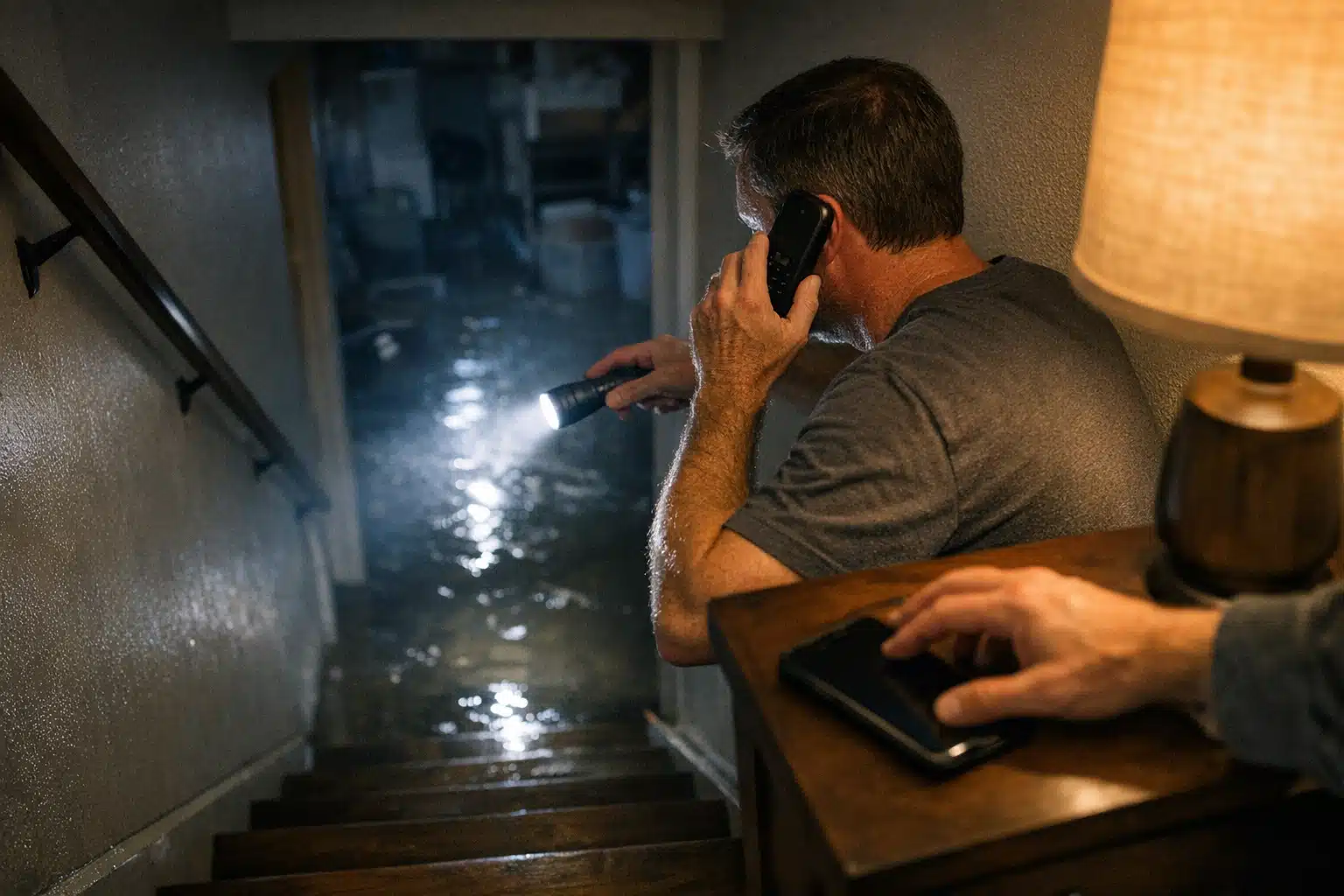
Most water damage calls hit between 9 PM and 6 AM, when your office is dark and your ads keep spending. Poor after hours restoration lead handling is where restoration owners quietly lose thousands each storm season. A homeowner with a flooded basement calls three companies in four minutes and hires whoever picks up first.
The choice comes down to two paths: a live answering service or on-call technicians. Both work. The wrong one paired with the wrong marketing burns your budget.
This post breaks down when each option wins, the response-time standards to set, and how to change your ads, Google Business Profile, and website based on who answers the phone.
After Hours Restoration Lead Handling: The Two Real Choices
After hours restoration lead handling means having a defined system to answer, qualify, and dispatch emergency calls outside business hours. For restoration companies, that system decides whether nighttime ad spend converts or evaporates.
You have two paths. Here is how they compare on the metrics that move revenue.
Live Answering Service
A live answering service uses trained agents to pick up every call, gather details, and text or dispatch your team. It costs less than staffing techs overnight. It works when your call volume is steady but not massive.
- Cost: Usually $1–$2 per minute or a monthly plan of $200–$800.
- Speed to answer: Under 30 seconds when the service is staffed for restoration.
- Weakness: Generic agents miss urgency cues and read scripts stiffly.
- Best for: Companies wanting zero missed calls without adding payroll.
On-Call Technicians
On-call techs answer their own phones and can commit to arrival on the same call. This builds instant trust with a panicked homeowner. It costs more in stipends and burns out staff if rotated poorly.
- Cost: On-call pay of $75–$150 per night plus mobilization fees.
- Speed to arrive: A tech can promise a 60-minute window on the phone.
- Weakness: Missed calls happen when a tech is already mid-job.
- Best for: Higher-ticket water and fire jobs where trust closes the deal.
The hybrid wins for most mid-size firms: an answering service screens the call, then patches qualified emergencies straight to the on-call tech.
Set Response-Time SLAs Before You Spend Another Dollar on Ads
Marketing sends the call. Operations decides if you keep the job. An SLA (service level agreement) is your internal promise on speed.

Without one, your ads pay for calls that ring out or sit in voicemail. Set clear numbers your whole team knows by heart.
- Answer within 3 rings, 24/7. Every ring past the third loses roughly 10% of callers.
- Qualify in under 90 seconds. Address, damage type, insurance status, and callback number.
- Dispatch confirmation within 5 minutes. Text the homeowner a name and arrival window.
- On-site within 60–90 minutes. This is the promise your ads should make.
Post these SLAs where your team sees them. Track them monthly against your call logs.
Match Your Google Business Profile to Who Answers
Your Google Business Profile (GBP) drives most of your emergency calls. Nighttime searchers tap the call button first, then read reviews. What you set here must match what happens when they call.
If You Use an Answering Service
Set your GBP hours to Open 24 hours only if the service answers around the clock. Add “24/7 emergency response” to your business description. Mismatched hours trigger one-star reviews that say “nobody answered.”
If You Use On-Call Techs
Still set 24-hour availability, but train techs to answer even mid-job with a hold. Add a GBP post each storm season stating your after-hours guarantee. Reply to every review mentioning response time, good or bad.
Key point: Do not advertise 24/7 on your GBP unless your phone truly gets answered at 2 AM.
Rewrite Your Emergency Landing Page for Panic Callers
A homeowner standing in two inches of water does not read paragraphs. Your emergency landing page needs one job: get the tap-to-call in under three seconds.
- Sticky call button at the top and bottom on mobile, always visible.
- Response promise in the headline: “Technician at Your Door in 60 Minutes — Call 720‑885‑0749.”
- Trust signals near the button: IICRC certification, insurance-billing note, review count.
- No contact form as the primary action. Forms lose emergency leads.
If an answering service handles the call, add a line: “Live agents answer 24/7.” If techs answer, say “Speak directly with a restoration technician now.”
The messaging must promise exactly what the caller gets. A broken promise at midnight becomes a public review by morning.
Adjust Your Ads by Time of Day and Season
Paid search is where after-hours handling saves or wastes money fastest. If nobody answers at night, pausing night ads stops the bleed. If your handling is solid, night bids become your cheapest leads.
Dayparting Your Google Ads
Dayparting means adjusting bids by hour and day. Restoration search intent spikes after storms and overnight pipe bursts. Bid up when your team can respond and down when it cannot.
- Pull your call-tracking data by hour for the last 90 days.
- Find the hours with the highest answered-call-to-job rate.
- Raise bids 20–40% during those windows.
- Lower bids or pause hours where calls go unanswered.
Seasonal Budget Shifts
Freeze-thaw cycles drive January pipe bursts. Spring and summer storms drive water and mold calls. Move budget into the weeks your local weather creates demand.
Never run 24-hour click-to-call ads without confirmed 24-hour answering. That is paying for calls you will lose.
Track Every After-Hours Lead by Source
You cannot fix what you do not measure. Call tracking ties each ring to its ad, keyword, or GBP listing. It also records whether the call was answered.
- Use a separate tracking number for your answering service.
- Use another for GBP and one for paid search.
- Review missed and abandoned calls weekly, not monthly.
- Calculate cost per answered lead, not cost per call.
Restoration answering service leads should show a lower abandon rate than voicemail-only handling. If they do not, the service is not built for emergency dispatch.
A Real Scenario: The Two-Minute Test
One Denver water-damage firm ran $4,000 monthly in night ads with voicemail after hours. Their call logs showed 38% of overnight calls went unanswered. That is roughly $1,500 in wasted spend each month.
They added an answering service that patched emergencies to an on-call tech. Answered-call rate jumped to 94%. Booked jobs from night calls rose without adding a single dollar to the ad budget.
The fix was operational, but the payoff showed up in marketing ROI. That connection is what most owners miss.
Which Should You Pick?
Pick an answering service if you run steady volume, want zero missed calls, and cannot justify overnight payroll. Pick on-call techs if trust and speed close your high-ticket fire and water jobs. Run the hybrid if you can afford both and want the strongest close rate.
Whatever you choose, set the SLAs, match your GBP and landing page, and daypart your ads to your true capacity.
Turn After-Hours Calls Into Booked Jobs
Strong after hours restoration lead handling starts with a clear SLA, matches your marketing to who answers, and tracks every call by source. Get these three aligned and your night ad spend converts instead of leaking. The restoration companies winning storm season are the ones answering at 2 AM.
The Restoration Marketers builds emergency landing pages, dayparted ad campaigns, and call-tracking systems for restoration firms. Call or text us at 720‑885‑0749, or visit https://restorationmarketers.com to audit your after-hours lead flow.
Sources
- Think with Google – Mobile Search Consumer Behavior
- IICRC – Institute of Inspection Cleaning and Restoration Certification
- Google Business Profile Help – Edit Your Business Hours
- Insurance Information Institute – Homeowners Insurance Facts and Statistics