
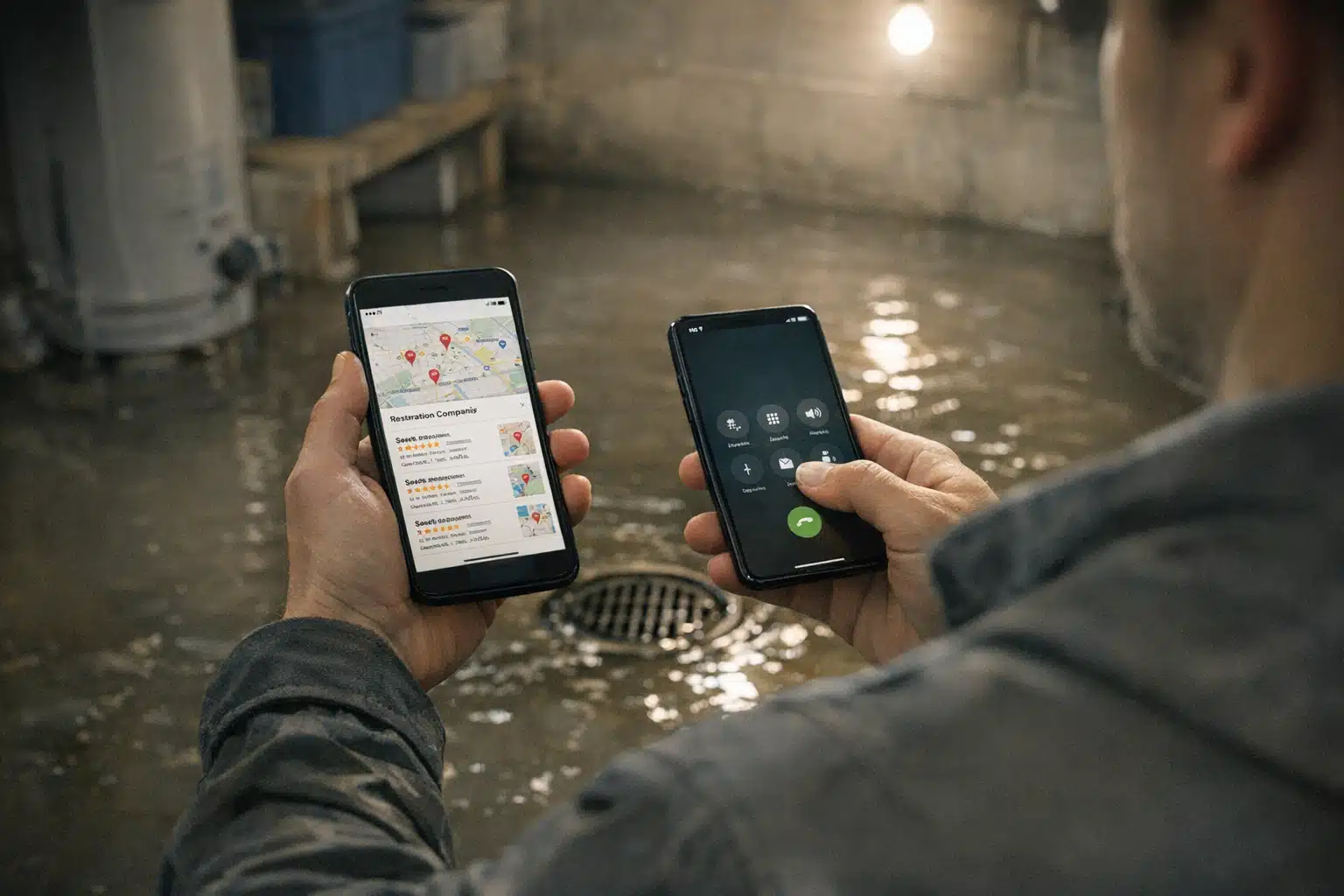
A single burst pipe generates a search, a phone call, and a Google review request within 48 hours. When a storm hits your service area, water damage searches can jump 300% overnight. If your restoration company only shows up in one place, most of that demand goes to a competitor. Multi-channel marketing puts your business in front of property owners across every place they look during an emergency.
This post breaks down how restoration companies build a connected marketing system across search, ads, reviews, and follow-up. You will learn how to time campaigns around storm season, track which channel produces paying jobs, and keep your phone ringing during slow months.
What Multi-Channel Marketing Means for Restoration Companies
Multi-channel marketing for restoration companies means being visible across search engines, maps, paid ads, and reputation platforms at the same moment a property owner needs help. It connects each touchpoint so a lead who finds you on Google Ads also sees strong reviews and a fast-loading emergency page.
Restoration marketing differs from standard home services work in one way: demand spikes without warning and buyers decide in minutes. A homeowner with three inches of water in the basement does not compare five estimates over a week. They call the first credible company they find.
Your channels have to work together to be that first credible company. A great ad that sends traffic to a slow page wastes money. Strong reviews that never appear in search results never get seen.
Why One Channel Is Not Enough
Insurance-referral dependence leaves restoration companies exposed when a preferred vendor program changes rules. Relying only on Google Ads means your cost-per-lead climbs every storm season as competitors flood the auction.
Spreading demand generation across channels protects revenue when any single source dries up. Here is what a connected system covers:
- Local SEO and Google Business Profile for map-pack visibility on emergency searches
- Google Ads and Local Services Ads for immediate top-of-page placement
- Review generation to build trust before the call happens
- Landing pages built for one-tap emergency calls
- Email and text follow-up for insurance jobs with long approval cycles
How Local SEO Drives More Water Damage Leads
Local SEO for restoration companies means optimizing your presence for high-intent emergency searches like “water damage restoration near me.” These searches carry the strongest buying intent because the property owner has an active problem right now.

The map pack, the three business listings above regular results, captures the majority of emergency clicks. Ranking in the map pack matters more than ranking first in blue links for restoration work.
Optimizing Google Business Profiles for Emergencies
Your Google Business Profile is the single highest-return asset for restoration lead flow. Treat it as your emergency storefront.
- Set your hours to 24/7 if you run emergency response. Profiles marked open outrank closed ones during off-hours searches.
- Add every service category for water, fire, mold, and storm damage separately.
- Post weekly updates with recent job photos and city names in the captions.
- Answer questions in the Q&A section before competitors do.
- Load real project photos from completed restorations, not stock images.
City-specific service pages support the profile. A company covering five suburbs needs a page for each, with local job examples and named neighborhoods.
Timing Paid Ads Around Storm Season
Paid ads produce leads on day one, which matters when demand appears overnight. The mistake most restoration companies make is running the same budget year-round.
Seasonal budget adjustment beats a flat monthly spend every time. Pull budget forward when weather patterns signal demand and cut waste during quiet stretches.
How to Budget Ads by Season
Match spend to the demand curve in your region. A Gulf Coast firm plans around hurricane season; a Midwest firm plans around spring flooding and winter pipe bursts.
- Pre-season: Build campaigns and raise budgets two weeks before your regional peak.
- Peak surge: Increase daily caps and add Local Services Ads to grab overflow demand.
- Off-season: Shift budget toward mold and reconstruction keywords with steadier volume.
- Slow months: Reduce ad spend and redirect it to review generation and content.
Google Ads vs. Local Services Ads for Restoration
Both belong in a connected system, but they serve different roles:
- Local Services Ads charge per lead, show a Google Screened badge, and sit at the very top. Best for emergency capture with verified trust signals.
- Google Ads (search) charge per click and let you control landing pages and messaging. Best for controlling the after-click flow and remarketing.
Run Local Services Ads for raw emergency leads and search ads for pages you control. Together they cover both trust and message control.
Building Landing Pages That Convert Emergency Calls
An emergency landing page has one job: get a panicked property owner to call within seconds. Every element either moves them toward the phone or gets removed.
A click-to-call button fixed to the top of the screen belongs on every restoration landing page. Property owners on phones will not scroll to find your number.
Elements Every Restoration Landing Page Needs
- Response-time promise stated up top, such as “On-site in 60 minutes”
- Phone number visible without scrolling, tappable on mobile
- Trust markers like IICRC certification and insurance-billing support
- Review snippets pulled from Google, shown near the call button
- Page load under three seconds so anxious visitors never bounce
Slow pages kill emergency conversions. Data from Google shows bounce probability rises sharply as load time climbs past three seconds.
Tracking Leads by Source Across Every Channel
Multi-channel marketing only works when you know which channel produces paying jobs. Restoration owners burn budget on channels that look busy but book nothing.
Track leads to the dollar, not to the click. A channel with fewer leads that close at higher value beats a flood of tire-kickers.
A Simple Lead-Tracking Setup
- Use call tracking numbers for each channel so every phone lead ties back to its source.
- Tag form submissions with the page and campaign that produced them.
- Record job value in your CRM against the original lead source.
- Review cost-per-booked-job monthly, not cost-per-lead.
- Cut or scale channels based on booked revenue, not vanity metrics.
One restoration client discovered their cheapest leads by cost came from Local Services Ads, but their highest-value fire jobs came from organic search. That split changed how they allocated budget across the year.
Reputation Recovery After Negative Reviews
Reviews decide restoration calls before the phone rings. A single one-star review during storm season can pull down a profile that took years to build.
A steady flow of new reviews outweighs the damage of one bad rating. Volume and recency protect your ranking and your click rate.
A Review System That Runs Itself
- Send a review request by text the moment a job closes, when satisfaction peaks
- Respond to every review, positive or negative, within 24 hours
- Address complaints publicly and calmly to show future customers how you handle problems
- Feature recent reviews on landing pages so trust carries across channels
Connected channels compound here. Strong reviews lift map-pack ranking, improve ad quality scores, and raise landing-page conversion at the same time.
Bringing the Channels Together
A connected system means a lead who searches sees your map listing, your ad, and your reviews as one consistent message. The property owner clicks a fast page, taps to call, and books the job.
Cohesion, not channel count, wins restoration jobs. Five channels working together beat ten channels running blind.
Conclusion
Effective restoration marketing starts with seasonally adjusted campaigns, fast lead response, and channels that reinforce each other. Track every lead to booked revenue, protect your reviews, and keep your emergency pages fast. That connected approach turns unpredictable demand into steady, trackable growth.
The Restoration Marketers builds multi-channel marketing systems designed for the demand swings restoration companies face. Call or text 720‑885‑0749, or visit https://restorationmarketers.com to get started.
Sources
- Google web.dev – Web Vitals and Page Load Performance
- Google Local Services Ads – How Local Services Ads Work
- IICRC – Institute of Inspection, Cleaning and Restoration Certification