
Nearly 70% of restoration customers never hire the same company twice, even after successful emergency repairs. This staggering customer retention problem costs restoration businesses thousands in repeat revenue and referrals each year.
The root cause isn’t service quality or pricing. Most restoration companies excel at emergency response and repairs. The issue lies in post-job communication and personalized marketing that keeps your company top-of-mind for future needs.
This walkthrough shows restoration owners how to build automated, personalized follow-up campaigns that turn one-time emergency customers into lifelong advocates for your business.
Why Standard Marketing Fails in Restoration
Generic email blasts and seasonal postcards don’t work for restoration customers. Your clients experienced a traumatic event – water damage, fire, or storm destruction. Their needs and emotions differ completely from typical home improvement shoppers.
Standard marketing treats all customers the same. It sends identical messages about “spring cleaning specials” to both fire victims and flood survivors. This approach ignores the personal nature of disaster recovery.
Restoration customers need marketing that acknowledges their specific experience and offers relevant value. A homeowner who survived basement flooding wants different information than someone recovering from kitchen fire damage.
The Insurance Timeline Challenge
Most restoration work involves insurance claims that span 3-6 months. Generic marketing campaigns don’t align with these extended timelines.
Your standard quarterly newsletter arrives when customers are still fighting claim adjusters. By the time they’re ready for additional work, your company is forgotten.
Building Personalized Marketing Campaigns That Increase Retention
Effective personalized marketing starts during the initial emergency call. Every interaction provides data points for future communication strategies.

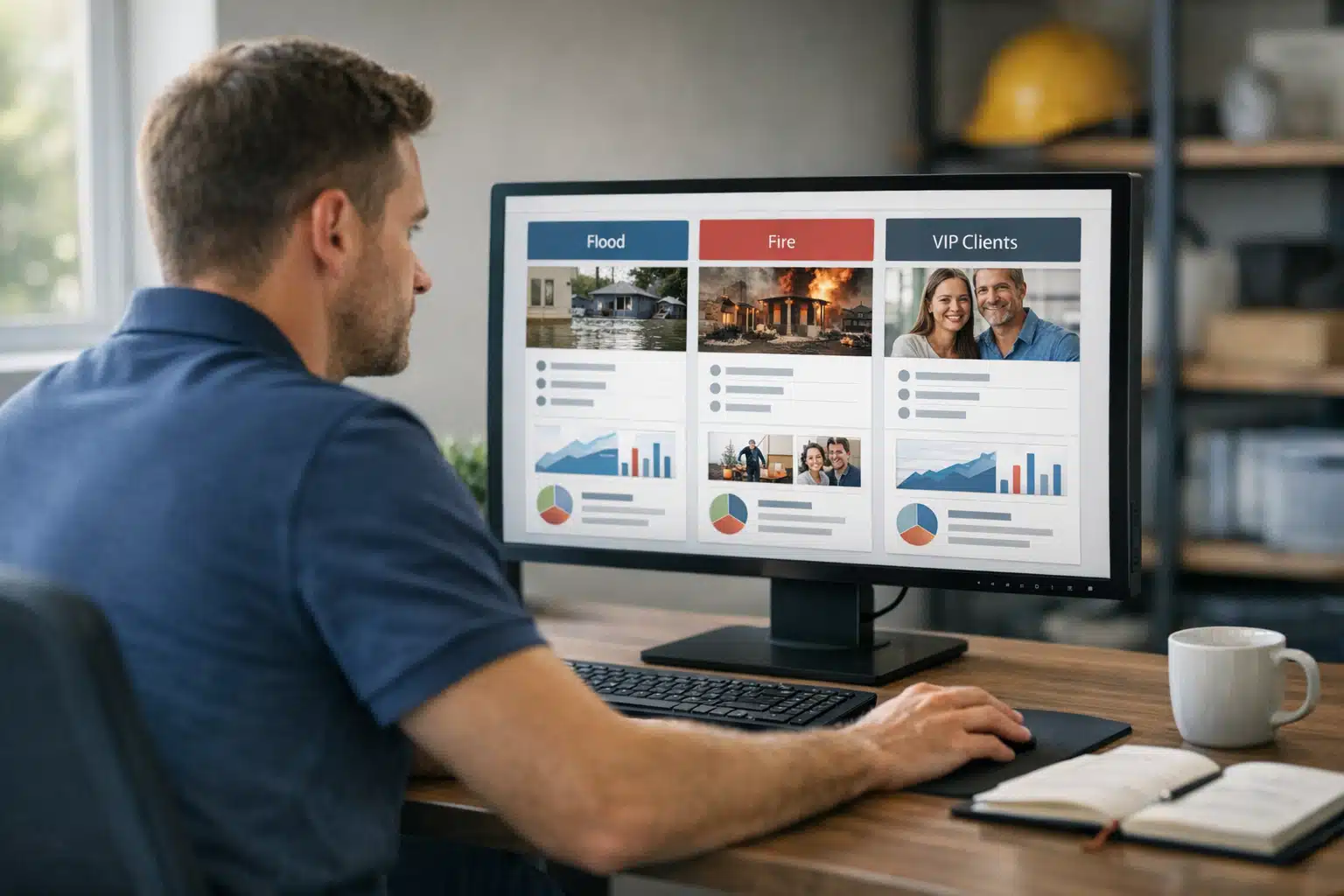
The key lies in segmenting customers by damage type, claim status, and restoration timeline. This data drives automated campaigns that send relevant messages at appropriate intervals.
Damage-Type Segmentation
Different disasters create different ongoing needs. Water damage customers worry about mold prevention. Fire victims need air quality monitoring advice. Storm damage clients prepare for seasonal vulnerabilities.
Your marketing automation should tag customers based on their primary restoration category:
- Water/Flood damage: Focus on moisture control and mold prevention
- Fire damage: Emphasize air quality and smoke remediation
- Storm damage: Highlight seasonal preparedness and roof maintenance
- Sewage backup: Address health concerns and system upgrades
- Biohazard cleanup: Provide ongoing safety and sanitization guidance
Timeline-Based Automation
Restoration customers move through predictable emotional and practical phases. Your automated campaigns should match these phases with appropriate messaging.
Week 1-2 (Crisis phase): Send practical tips for living in damaged homes, insurance documentation checklists, and emergency contact information.
Month 1-3 (Restoration phase): Share progress updates, explain restoration processes, and provide realistic timelines for completion.
Month 4-6 (Recovery phase): Focus on prevention tips, maintenance schedules, and early warning signs for future problems.
Month 6+ (Prevention phase): Offer seasonal inspections, maintenance packages, and referral incentives for satisfied customers.
Automation Tools for Restoration Marketing
Manual personalization doesn’t scale for busy restoration companies. You need automation platforms that trigger based on customer data and timelines.
Most restoration companies already use job management software. The best approach connects your existing system to email marketing platforms that support behavioral triggers.
Essential Automation Features
Your automation platform needs specific capabilities for restoration marketing:
- Custom field mapping: Import damage type, claim status, and completion dates from your job management system
- Date-based triggers: Send messages on specific anniversaries (6-month completion, 1-year follow-up)
- Conditional logic: Different message paths based on customer tags and behaviors
- SMS integration: Emergency preparedness alerts work better via text than email
- Local weather triggers: Automatic storm warnings for customers with previous weather-related damage
Integration with Job Management
The most effective automation pulls data directly from your restoration software. This eliminates manual data entry and keeps customer information current.
Popular restoration software platforms like Xactimate, DASH, and CompanyCam offer API connections to marketing automation tools. This integration automatically updates customer status and triggers appropriate campaigns.
Content Strategy for Restoration Follow-Up
Personalized campaigns need relevant content for each customer segment. Generic home maintenance tips won’t engage customers who survived major disasters.
Your content strategy should address ongoing concerns specific to each damage type. This positions your company as the expert they’ll call for future problems.
Water Damage Follow-Up Content
Water damage customers worry about hidden moisture and future mold growth. Your follow-up content should address these specific concerns:
- Monthly moisture level checks for the first year
- Seasonal humidity control tips
- Early warning signs of recurring water problems
- Insurance-approved maintenance practices
- Professional inspection schedules
Fire Damage Communication
Fire restoration customers need ongoing air quality and safety information. They’re more likely to invest in prevention systems after experiencing property loss.
Your fire customer content should cover:
- Smoke detector maintenance schedules
- HVAC filter replacement for ongoing air quality
- Electrical system monitoring tips
- Fire-safe landscaping and storage practices
- Insurance discounts for prevention upgrades
Measuring Customer Retention Success
Effective measurement tracks both short-term engagement and long-term customer retention metrics. Your campaigns should improve both email response rates and actual repeat business.
The most important metrics for restoration marketing focus on customer lifetime value rather than single campaign performance.
Key Performance Indicators
Track these specific metrics to measure your personalized marketing success:
- Repeat customer rate: Percentage of customers who hire you for additional work within 24 months
- Referral generation: New customers attributed to existing customer recommendations
- Email engagement by segment: Open and click rates for different damage type campaigns
- Maintenance package uptake: Customers who purchase ongoing prevention contracts
- Review and testimonial rates: Positive online reviews generated by follow-up campaigns
ROI Calculation for Retention Marketing
Restoration companies should measure marketing ROI based on customer lifetime value, not single-job profit margins. A customer who returns for additional work or refers new business provides exponentially higher value.
Calculate your retention marketing ROI using this framework: (Repeat revenue + referral revenue – marketing costs) / marketing investment = ROI percentage.
Most restoration companies see 300-500% ROI on personalized follow-up campaigns within the first year of implementation.
Seasonal Campaigns for Maximum Impact
Restoration marketing becomes more effective when aligned with natural disaster seasons and prevention cycles. Customers are most receptive to your messages before they need emergency help.
Your automated campaigns should include seasonal triggers based on local weather patterns and historical damage data.
Storm Season Preparation
Customers who experienced storm damage are prime candidates for prevention investments. They understand the true cost of emergency repairs and insurance deductibles.
Pre-storm season campaigns should focus on:
- Roof and gutter inspections for previous storm customers
- Basement waterproofing for flood survivors
- Generator installation for power outage victims
- Emergency supply kits based on their previous experience
- Insurance policy reviews before renewal deadlines
Anniversary-Based Outreach
The anniversary of a customer’s original damage creates a powerful marketing opportunity. Most homeowners remember the exact date of major disasters.
Anniversary campaigns work best when they acknowledge the difficulty of the original experience and highlight the customer’s recovery progress. This emotional connection drives higher response rates than generic promotional messages.
Implementation Timeline for Restoration Companies
Most restoration companies can implement basic personalized marketing within 30-60 days. The key is starting with simple automation and expanding based on results.
Week 1-2: Set up customer segmentation in your email platform and create damage-type tags for existing customers.
Week 3-4: Build your first automated campaign focusing on your most common damage type (usually water damage).
Month 2: Launch campaigns for additional damage types and begin tracking engagement metrics.
Month 3+: Expand automation with seasonal triggers, anniversary campaigns, and advanced segmentation based on customer behavior.
Start with your most recent customers who remember your company positively. These early adopters provide the best testing ground for your personalized campaigns.
Getting Started with Retention Marketing
Personalized marketing transforms one-time emergency customers into long-term business relationships. The right automation sends relevant messages that address ongoing concerns specific to each damage type.
Successful restoration companies combine customer data, timeline-based automation, and damage-specific content to create campaigns that actually help customers while generating repeat business. Most see measurable increases in customer retention within 90 days of implementation.
The Restoration Marketers specializes in building automated marketing systems that increase customer retention for restoration companies. Our team understands the specific challenges of disaster recovery marketing and creates campaigns that connect with customers’ real experiences. Contact us at 123-456-7890 to learn how personalized marketing can grow your restoration business.
Sources
- FEMA – National Flood Insurance Program Statistics
- Institute of Inspection, Cleaning and Restoration Certification – Consumer Care and Maintenance
- Small Business Administration – Disaster Assistance Programs