
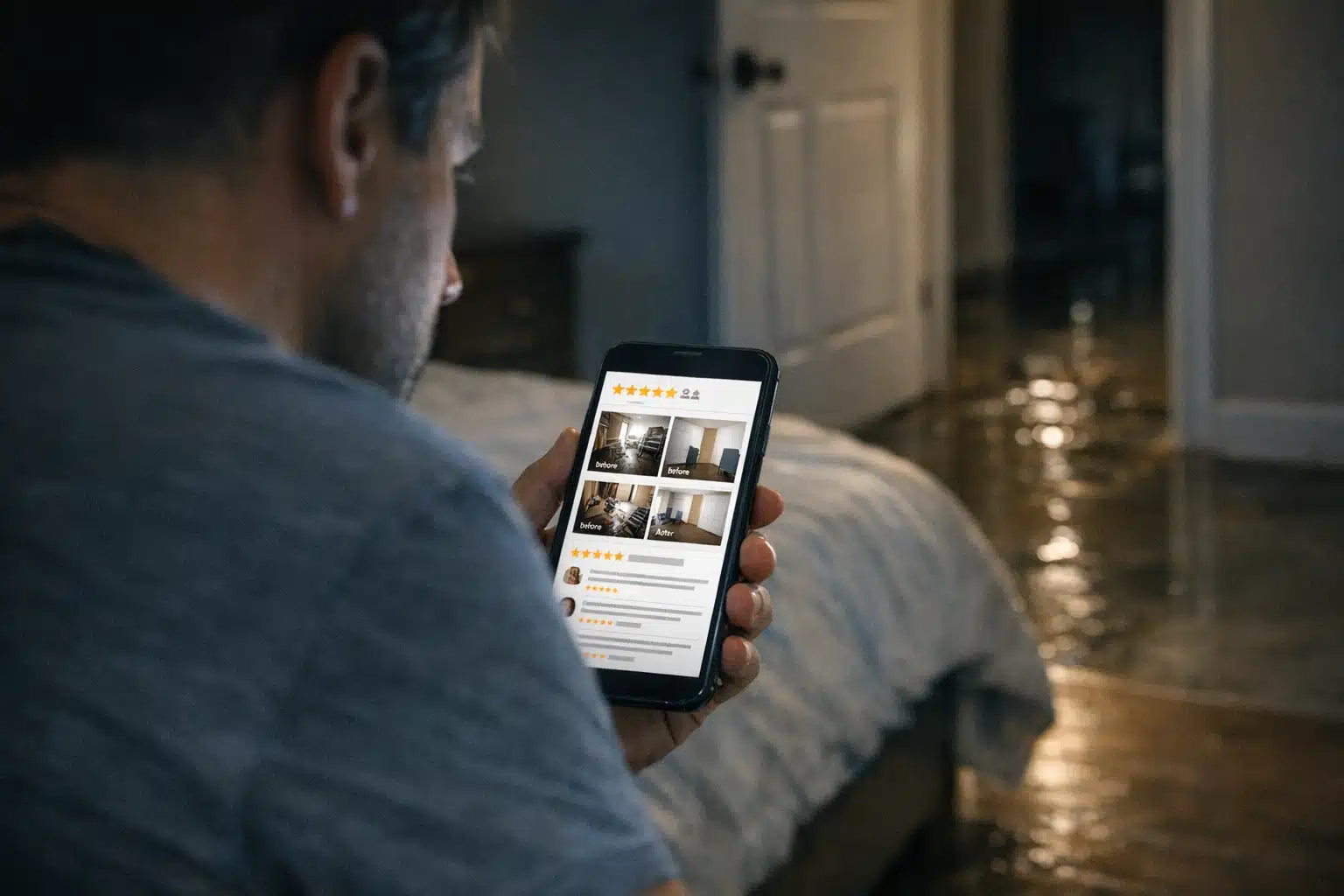
When a homeowner’s basement floods at 2 a.m., they grab their phone and search for help. The first thing they check is not your pricing. It is your reviews, ratings, and photos of past jobs. That instant credibility check is social proof, and it decides whether they call you or your competitor down the street.
Restoration buyers act under stress, on tight timelines, and with insurance money on the line. That makes trust signals more powerful in restoration than in almost any home service category. This post breaks down how to collect, place, and measure social proof to win more emergency calls.
You will learn where reviews matter most, how to turn storm-season jobs into proof, and how to recover after a bad review sinks your rating.
Why Social Proof Matters More in Restoration Than Other Home Services
Social proof means evidence from other people that your work is reliable. In restoration, that evidence carries extra weight because customers cannot judge the job in advance.
A homeowner hiring a landscaper can see photos of finished lawns. A flood victim is buying an invisible promise: dry walls, no mold, and a clean insurance claim. They lean on other people’s words to trust that promise.
Restoration is an emergency purchase, so buyers convert on trust, not comparison shopping. They rarely get three quotes at midnight. They pick the company that already looks proven.
The Three Proof Signals Buyers Check First
- Star rating and review count on your Google Business Profile
- Recent reviews that mention their exact problem, like “sewage backup” or “wind damage”
- Before-and-after photos that match their situation
A profile with 180 reviews at 4.8 stars beats a five-star profile with 6 reviews. Volume signals that many neighbors trusted you and none regretted it.
How to Collect Reviews That Match Real Restoration Scenarios
Generic reviews help less than specific ones. A review that says “great company” does little. A review that says “they extracted water from my flooded kitchen in two hours and handled State Farm directly” pre-sells your next lead.

Ask for reviews at the moment of relief, right after the customer signs off on a finished job. That emotional peak produces detailed, glowing feedback.
A Simple Review Request Sequence
- Send a text with a direct Google review link within one hour of job completion.
- Prompt the customer with a question: “What surprised you most about how we handled your water damage?”
- Follow up once by text after 48 hours if no review posts.
- Log which technician earned each review to reward top performers.
The prompt question matters. It pushes customers to write about the specific damage type and your response speed, which future searchers scan for.
Ask for the review by text, not email. Restoration customers respond faster to their phones.
Turning Storm Season Into a Proof-Building Machine
Storm season creates a lead surge and a proof surge at the same time. When a hailstorm or hurricane hits your service area, you run dozens of jobs in weeks. Each one is raw material for content.
Document every large-loss job with photos and short customer quotes. Tag each by damage type: roof leak, flooded crawlspace, or storm debris.
Publish a “storm response” page on your site after each major weather event. List the neighborhoods you served and stack the fresh reviews from that storm.
Why Timing Beats Volume
Reviews from the last 30 days carry more weight with both Google and buyers. A cluster of storm-week reviews tells searchers you were active and available during the exact crisis they now face.
Front-load review requests during your busy season, when jobs and customer gratitude both peak.
Using Social Proof to Win Insurance Referral Trust
Many restoration firms depend on insurance adjusters and agents for referrals. Those partners send business to companies that make them look good to policyholders.
Public reviews mentioning smooth claims handling build referral trust. When an adjuster sees dozens of comments praising your paperwork and communication, they route more clients your way.
- Highlight reviews that mention working with a named carrier or handling the claim directly.
- Feature a case study page showing a full claim from first call to final payment.
- Share proof of certifications like IICRC on your profile and site.
Insurance partners refer companies that reduce their headaches. Reviews prove you do exactly that.
Placing Social Proof Where It Converts Calls
Collecting proof means little if it hides on a testimonials page nobody visits. Put it where buyers decide.
Emergency Landing Page Placement
- Show star rating and review count in the header, next to your phone number.
- Place two short reviews above the call button on mobile.
- Add a before-and-after slider matching the page’s damage type.
- Display trust badges like BBB and IICRC near the form.
A water damage landing page should carry water damage reviews. A mold page should carry mold reviews. Matching proof to intent lifts conversion.
Proof that matches the visitor’s exact problem converts far better than generic praise.
Google Business Profile as Your Proof Hub
Your Business Profile is where most emergency searches land. Post job photos weekly, respond to every review, and answer questions in the Q&A section.
Responding to negative reviews calmly shows future buyers how you handle problems. That response is proof in itself.
Recovering From a Bad Review or Rating Drop
One angry review can scare off leads for months. Reputation recovery is part of any serious restoration marketing plan.
Respond to the negative review within 24 hours with a factual, calm reply. Never argue. State what you did and offer to make it right offline.
- Reply publicly with empathy and facts, not defensiveness.
- Fix the underlying issue if the complaint is valid.
- Ramp up requests to happy customers to dilute the bad rating.
- Track your star average weekly until it recovers.
You cannot delete most bad reviews, but you can outweigh them with volume and a strong public response.
Measuring Whether Your Social Proof Actually Drives Leads
Proof is a marketing asset, and assets deserve tracking. Tie your review activity to lead flow so you know it pays off.
- Track call volume from your Google Business Profile month over month.
- Watch landing page conversion rates before and after adding reviews.
- Ask new callers how they found you and whether reviews influenced them.
- Monitor your review velocity: new reviews per week during and after storm season.
Companies that treat reviews as a tracked metric grow faster than those that collect them by accident. Strong marketing strategies connect proof to measurable lead gains.
Conclusion
Social proof turns anxious emergency searchers into paying customers by proving you handled their exact problem before. Collect specific reviews during storm season, place them where buyers decide, and respond fast when ratings dip. Trust-focused marketing strategies win the restoration jobs your competitors lose.
The Restoration Marketers helps restoration companies build review systems, reputation recovery plans, and high-converting landing pages. Call or text us at 720‑885‑0749, or visit https://restorationmarketers.com to grow your lead flow.
Sources
- Google – Reply to Reviews on Your Google Business Profile
- IICRC – Institute of Inspection Cleaning and Restoration Certification
- Better Business Bureau – Business Ratings and Reviews