
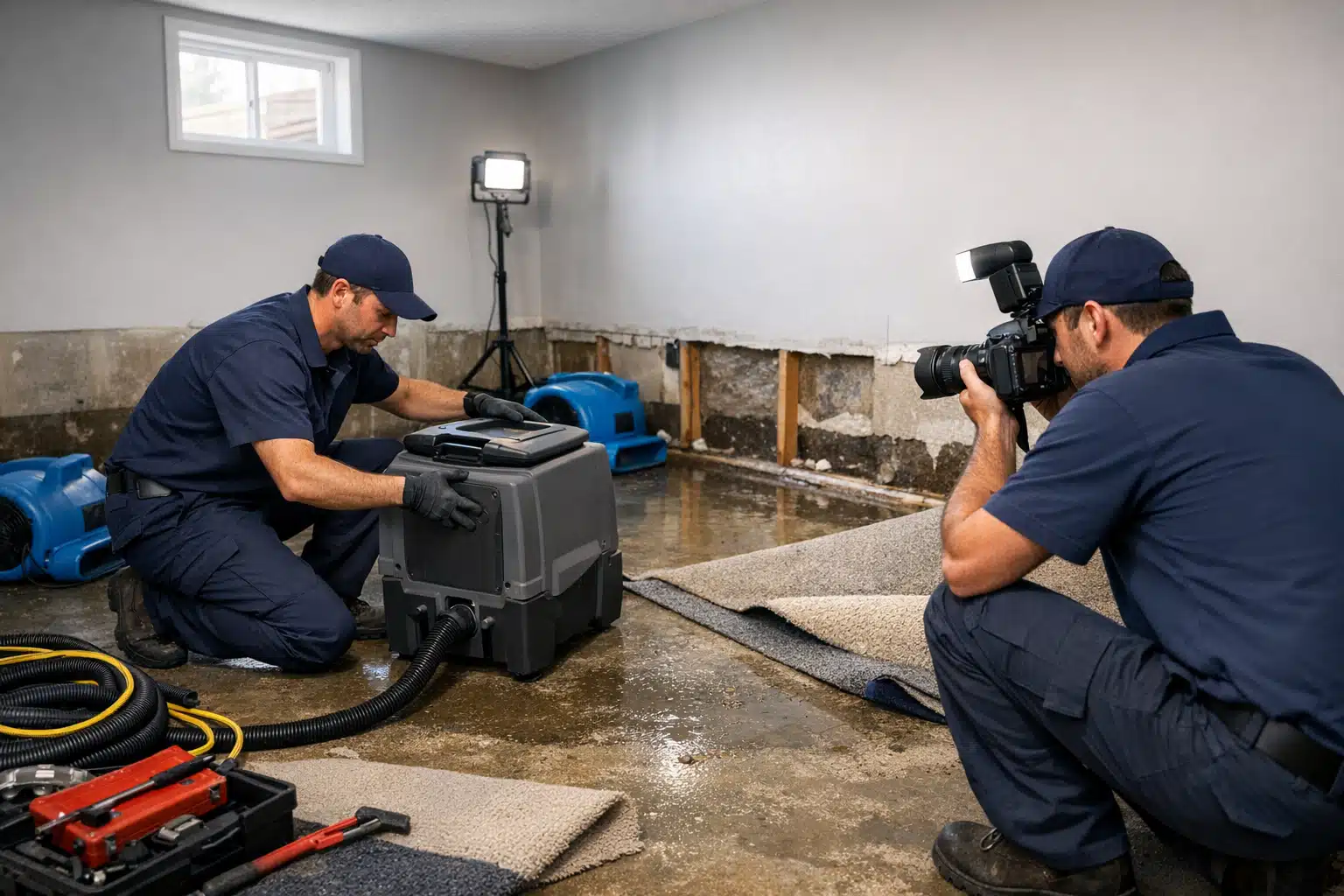
Most restoration companies lose jobs in neighboring towns before the phone ever rings. Google shows a local competitor first, and that competitor books the water damage call. You can rank without office restoration locations in those towns—but only if you build the right kind of proof.
Fake addresses and virtual offices get suspended. Google has cracked down hard on that tactic. What works instead is a “proof stack”: real evidence that you serve the area and do good work there.
This post breaks down exactly what belongs in your proof stack, what to skip, and how to earn visibility in surrounding communities without risking a listing suspension.
Why You Can Rank Without an Office in Restoration
Restoration is a service-area business. You go to the customer during a flood, fire, or mold event. Google knows this, and its rules account for it.
A service-area business can list without a physical storefront address. You hide your address and define the cities you cover. That single setting is the honest foundation for reaching nearby towns.
The trap most owners fall into is thinking they need a real location in every town. They don’t. They need proof of service in each town instead.
What Google Actually Rewards
Google ranks the business it trusts most for a given town. Trust comes from signals it can verify—reviews mentioning the area, links from local sites, and content that shows real work.
A virtual office in a UPS Store does none of that. It creates risk without building trust. Skip it entirely.
The Proof Stack You Need for Local SEO in Nearby Cities
Your proof stack is the collection of real evidence that ties your company to each town you serve. Strong local SEO for nearby cities depends on it. Here is what belongs inside.
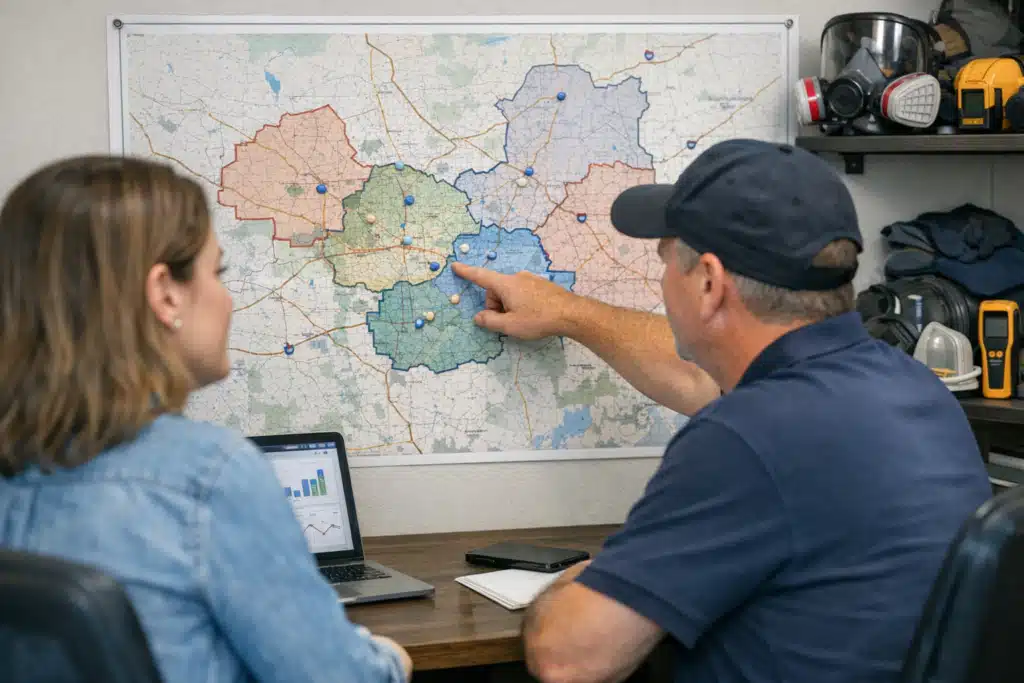
1. Job-Site Case Studies by Town
Write a short case study for real jobs in each target town. Name the town, describe the damage, and explain what you did.
Example: “Basement flood cleanup in Aurora after a July storm—3,200 sq ft dried in four days.” That sentence tells Google and a homeowner you were physically there.
One documented job per town beats ten pages of generic filler.
2. Geotagged Project Photos
Before-and-after photos carry weight when they show real work. Keep the location data intact when you upload them.
- Photograph the drying equipment on site
- Capture the moisture readings and the finished repair
- Include a visible landmark or street when appropriate
- Upload the images to the matching town page and your Google Business Profile
A homeowner in the next town over sees proof, not promises.
3. Reviews That Name the Town
Reviews are the strongest ranking signal you control. A review that names the town does double duty—it builds trust and feeds local relevance.
Ask every customer to mention their town in the review. A simple prompt works: “Would you note which city we helped you in?”
Twenty reviews spread across five towns will outrank one office with fifty reviews from a single city.
4. Local Citations and Partners
Citations are mentions of your business name, phone, and website on other sites. For nearby-town ranking, prioritize the ones tied to that area.
- Local chamber of commerce directories in each town
- Regional plumber and roofer partners who refer you
- Insurance adjuster and agent listings in the area
- Community sponsorship pages from teams or events you fund
A link from an Aurora youth sports team you sponsor proves you belong there. That beats a paid directory listing every time.
5. Town-Specific Landing Pages
Build one page per town, and make each one real. Thin, copy-pasted pages with the town name swapped get ignored or penalized.
Each page should carry the case study, the photos, a town-named review, and a note about local response times. That combination signals genuine service, not a doorway page.
What Does Not Matter (Stop Wasting Money Here)
Restoration owners burn budget on tactics that do nothing for nearby-town ranking. Here is what to cut.
Fake or Virtual Addresses
Renting a mailbox address in a town you want to rank in is the fastest way to get suspended. Google’s field verification and competitor reports catch these constantly.
One suspension can erase years of ranking progress in a single day.
Keyword-Stuffed Business Names
Adding “Water Damage Aurora Denver Fire Restoration” to your Google name violates the rules. Competitors report it, and Google reverts it. Use your real business name only.
Mass-Produced Doorway Pages
Fifty town pages built from one template, with only the name changed, add no value. Google’s spam systems flag the pattern. Fewer real pages win.
Buying Cheap Citation Packages
Bulk citation gigs post your business to hundreds of dead directories. They add noise, not authority. The chamber page in your target town matters more than 300 auto-listings.
How Restoration Ranking Differs From General Home Services
Restoration marketing follows different rules than a handyman or landscaper faces. The stakes and timing change the playbook.
Demand spikes with weather. A hailstorm or hard freeze creates a wave of searches in specific towns within hours. Your proof stack must already exist when that wave hits.
You cannot build town credibility during a storm—you build it in the quiet months.
Insurance and Referral Dependence
Many restoration jobs come from insurance adjusters and agents. Those partners often work across several towns. A referral partner page listing them strengthens both relationships and local relevance.
Reputation Recovery After a Bad Review
One angry review from a total-loss job can sink a small company’s ranking in a town. The fix is volume—steady, town-named reviews that outweigh the outlier over time.
A 30-Day Proof Stack Checklist
Use this order to build visibility in one target town at a time. Finish one town before starting the next.
- Confirm your Google Business Profile is set as a service-area business with the address hidden
- Add the target town to your service-area list
- Pull three recent jobs from that town and write a short case study for each
- Upload geotagged before-and-after photos to a new town page
- Request reviews from those three customers, asking them to name the town
- Claim your chamber of commerce and two local partner listings
- Publish the town landing page with case study, photos, and reviews
- Track calls from that page with a dedicated tracking number
Repeat this cycle monthly, and your map presence in surrounding towns grows without a single fake address.
Tracking Which Towns Pay Off
Assign a call-tracking number to each town page. When a call comes in, you know which town and which page produced it.
After 90 days, double down on towns that convert and rework the ones that don’t. Data beats guessing on where to spend next.
The Takeaway
You can rank without office restoration locations by proving real service in each town—case studies, geotagged photos, town-named reviews, and local partner citations. Skip virtual addresses, stuffed names, and cheap directory packages that risk suspension and waste money. Build your proof stack in the quiet months so it is ready when storm season sends leads flooding in.
The Restoration Marketers builds town-by-town local SEO for nearby cities without cutting corners that get you suspended. Call or text us at 720‑885‑0749, or visit https://restorationmarketers.com to map out your proof stack.